
Analyzing the global mica stablecoin market share reveals a dramatic turning point in how digital liquidity is governed, traded, and distributed across world markets. When the European Union enacted the Markets in Crypto-Assets (MiCA) regulation, it established the planet’s first comprehensive legal framework for digital assets. While many observers assumed the rules would only affect European exchanges, the enforcement of Titles III and IV (governing asset-referenced tokens and e-money tokens) sent massive shockwaves through global crypto liquidity.
The days of regulatory arbitrage in the stablecoin sector are officially over. By imposing strict reserve segregation rules, mandatory banking deposit ratios, and explicit authorization requirements, MiCA is actively restructuring the hierarchy of digital dollar dominance.
The Two Regulatory Buckets: EMTs vs. ARTs
Under the MiCA regime, the broad label “stablecoin” was replaced by two distinct, strictly supervised asset classes:
-
Electronic Money Tokens (EMTs): Tokens that reference the value of a single official fiat currency (such as the US Dollar or Euro). EMT issuers must be authorized credit institutions or licensed Electronic Money Institutions (EMIs) within the EU.
-
Asset-Referenced Tokens (ARTs): Tokens that reference a basket of assets, commodities, or multiple currencies. These require direct national competent authority approvals and face stringent capital adequacy rules.
Because single-currency tokens represent the vast majority of global liquidity, the battle for European market share has played out almost exclusively across the EMT category.
The Offshore Liquidity Divide and Exchange Delistings
The most immediate impact of MiCA on global market dynamics has been the physical fracturing of exchange liquidity between compliant EMTs and non-regulated offshore tokens.
Under MiCA rules, any Crypto-Asset Service Provider (CASP) operating within the European Economic Area (EEA) is legally prohibited from offering non-authorized stablecoins to retail and institutional users. Crucially, MiCA mandates that significant EMT issuers hold at least 60% of their backing reserves directly as cash deposits across multiple independent commercial banks.
This reserve composition requirement triggered a major market split:
-
USDC and Compliant Issuers: Circle secured early EMI licensing in Europe, making USD Coin (USDC) and EURC fully compliant EMTs. As a result, regulated European trading desks, fintech applications, and top exchanges immediately expanded support for USDC trading pairs.
-
USDT and Offshore Friction: Tether’s primary reliance on U.S. Treasury bills and alternative reserve structures led major global exchanges to restrict or delist USDT pairs for EEA residents. While Tether remains dominant across emerging markets and Asian trading hubs, its market share inside regulated European borders faced substantial structural headwinds.
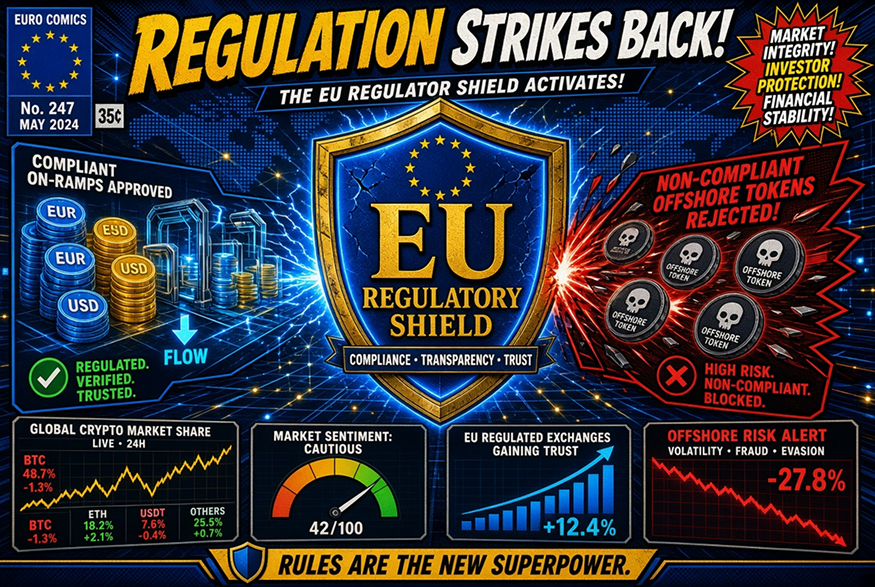
The regulatory enforcement funnel operates through three direct stages: global liquidity enters the compliance screening process, compliant EMT rails receive institutional clearance, and non-compliant assets face systematic delistings and geo-fencing across European platforms.
The Rise of Regulated Euro-Denominated Stablecoins
Historically, the stablecoin market was 99% dollar-denominated, with Euro stablecoins representing a negligible fraction of global volume. MiCA has begun shifting this dynamic by establishing a clear legal framework that gives European commercial banks and traditional payment giants the legal certainty to issue native Euro-pegged tokens.
With over 20 licensed EMT issuers active across the European Union, euro-backed stablecoins are transitioning from speculative trading instruments into viable settlement rails for corporate B2B cross-border payments, supply chain invoicing, and institutional tokenized cash sleeves.
Global Stablecoin Structural Comparison Under MiCA
| Feature / Metric | MiCA Compliant EMTs (e.g., USDC) | Unregulated Offshore Stablecoins |
| EU Legal Status | Fully Authorized for Public Offering & Trading | Banned or Restricted from EU CASP Listing |
| Reserve Composition | Mandatory 30% to 60% in Commercial Bank Deposits | Discretionary Mix (Predominantly T-Bills & Private Credit) |
| Redemption Rights | Guaranteed Unconditional Par Redemption at Face Value | Discretionary, Subject to Issuer Terms & Fees |
| Direct Supervision | European Banking Authority (EBA) & National Regulators | Offshore Regulatory Jurisdictions |
Global Repercussions: The Brussels Effect in Action
The structural transformation driven by MiCA extends far beyond European borders—a classic example of the “Brussels Effect”.
International institutional allocators, multi-national corporations, and sovereign wealth funds seeking counterparty protection are increasingly prioritizing MiCA-compliant stablecoin models. Furthermore, regulatory bodies in jurisdictions like the UK, Hong Kong, Singapore, and the United States are modeling their own domestic stablecoin reserve legislation on the transparency and capital preservation principles pioneered by the EU.
The Bottom Line
The global mica stablecoin market share evolution demonstrates that institutional adoption cannot thrive without regulatory clarity. While offshore tokens still capture substantial volume across global derivatives markets, MiCA has drawn a permanent line in the sand for regulated spot liquidity and enterprise finance. By standardizing bank-backed reserves and enforcing direct redemption rights, MiCA is successfully shaping the next generation of transparent, compliant digital money.