
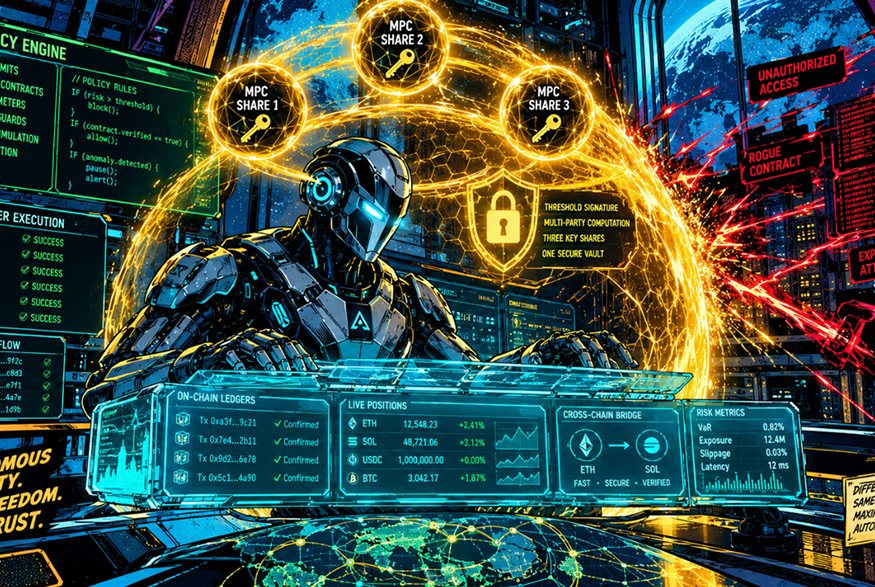
Implementing ai agent wallets mpc security has become a fundamental operational standard as autonomous artificial intelligence models begin managing, routing, and executing digital capital on-chain. While traditional crypto accounts were engineered for human users manually approving transactions through browser extensions or hardware devices, autonomous AI agents operate continuously at machine speed. Giving an autonomous model unconstrained access to a standard private key or raw mnemonic seed phrase introduces extreme systemic risk; a prompt injection attack, model hallucination, or unhandled edge-case in an execution loop could instantly drain an entire treasury.
Multi-Party Computation (MPC) paired with programmable policy engines solves this fundamental safety issue. By splitting cryptographic signing authority across distributed, programmatic key shares, engineering teams can empower autonomous agents to trade, rebalance, and pay for services while enforcing strict, immutable security guardrails.
The Architecture of MPC-Secured Agent Infrastructure
In a conventional wallet, a single private key is assembled in memory to generate a digital signature. If an attacker breaches the agent’s host server or manipulates the LLM’s runtime environment, the full key is compromised.
Under a threshold MPC architecture (typically using 2-of-3 or 3-of-4 threshold signature schemes), the private key never exists in a single location:
-
Share 1 (The Autonomous Agent): Held in an isolated execution environment, secure enclave, or Trusted Execution Environment (TEE) managed by the AI agent’s host service.
-
Share 2 (The Automated Policy Engine): Held by an independent, hardened verification server that evaluates transaction payloads against deterministic business rules before co-signing.
-
Share 3 (The Human / Disaster Recovery Custodian): Stored in a cold, offline hardware security module (HSM) or institutional recovery vault, reserved exclusively for emergency pauses, parameter updates, or manual recovery.
Because the AI agent holds only a partial key share, it is mathematically incapable of broadcasting a valid transaction to a blockchain network on its own. The transaction can only execute if the policy engine independently verifies the payload and contributes the second key share.
Step-by-Step Implementation Workflow
Setting up an autonomous agent wallet with programmable MPC security follows four key technical phases:
Step 1: Distributed Key Generation (DKG)
Initialize a Distributed Key Generation ceremony using an enterprise-grade MPC protocol framework. During this mathematical handshake, the agent’s environment and the policy engine generate partial secret shares without ever revealing their values to one another or constructing a full master key. The public address derived from these shares is deployed on-chain to receive operating funds.
Step 2: Define the Deterministic Policy Engine Rules
Configure the policy engine that holds the co-signing share. The rules must be programmed deterministically so that malicious or hallucinated LLM requests are rejected before signing occurs:
-
Per-Transaction & Daily Velocity Caps: Limit single trades (e.g., maximum $5,000 equivalent per call) and set a hard rolling 24-hour total volume limit.
-
Strict Smart Contract Whitelisting: Restrict interactions exclusively to pre-audited protocol addresses and verified token router contracts. Calls to unverified contracts are immediately aborted.
-
Function Selector Gating: Restrict callable ABI signatures strictly to specific business actions (e.g., allowing
swapExactTokensForTokensorstake, while explicitly blocking arbitraryapproveortransfercalls to unknown recipients). -
Slippage & Price Impact Boundaries: Enforce maximum acceptable slippage thresholds (e.g., rejecting swaps where real-time oracle price feeds show greater than 1% price impact).
Step 3: Integrate Machine-to-Machine Intent Communication
Connect the AI agent to the MPC signing API using secure authenticated channels (such as mTLS or session keys with ephemeral cryptographic proofs). When the agent decides to execute an on-chain action, it constructs a standardized transaction intent and dispatches it alongside the partial signature generated by Share 1.
Step 4: Co-Signing and On-Chain Broadcast
The policy engine ingests the intent, simulates the transaction against a local test fork to verify expected state changes, and validates the transaction parameters against its hardcoded rules. If every check passes, the policy engine uses Share 2 to generate its threshold signature component. The two shares are combined into a standard, valid ECDSA or EdDSA signature and broadcast directly to the blockchain network.
Security Comparison: AI Agent Key Management Models
| Security Dimension | Plaintext Private Key | Smart Contract Multi-Sig | Programmable MPC Stack |
| Execution Latency | Sub-second (Unsafe) | Multi-second (Requires on-chain gas) | Sub-second (Off-chain math) |
| Gas Overhead | Baseline transaction cost | High (On-chain contract verification) | Baseline transaction cost |
| Exploit Blast Radius | Total balance drainage | Constrained to contract limits | Constrained by off-chain policy rules |
| Cross-Chain Portability | Universal | Requires redeployment per chain | Universal (Chain-agnostic signing) |
Mitigating Advanced Autonomous Threat Vectors
Deploying AI models directly into financial execution pipelines exposes systems to unique risks that traditional Web2 cybersecurity cannot fully mitigate:
-
Prompt Injection Resistance: Even if an adversarial prompt tricks an agent’s language model into sending treasury funds to an attacker’s wallet, the transaction fails automatically at the policy engine layer because the destination address is not on the cryptographic whitelist.
-
State Simulation Guards: Real-time simulations intercept flash loan attacks, sudden liquidity pool draining, or honeypot smart contracts by ensuring that the post-transaction token balance matches the expected trade output before the second key share signs.
-
Automated Circuit Breakers: If the agent triggers three consecutive policy violations within an hour, the policy engine locks automated co-signing and routes an alert to human administrators for manual review.
The Bottom Line
Structuring ai agent wallets mpc security environments provides the architectural bridge between artificial intelligence and decentralized finance. By isolating key shares across autonomous agents and deterministic policy engines, organizations can unleash autonomous agents to operate at full machine velocity without sacrificing institutional-grade risk management. This multi-layered defense guarantees that autonomous AI remains a powerful, productive financial tool rather than a catastrophic single point of failure.