
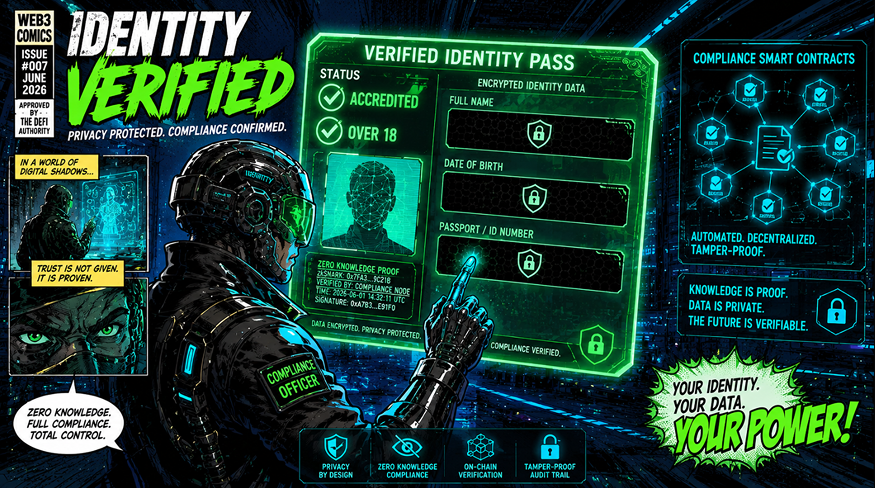
For years, the intersection of regulatory compliance and decentralized finance felt like an irreconcilable paradox. On one side stood global regulators enforcing strict Anti-Money Laundering (AML), Counter-Terrorist Financing (CTF), and European Data Protection (GDPR) mandates. On the other side stood the core architecture of public blockchains: transparent, immutable ledgers where storing sensitive Personally Identifiable Information (PII) is both a technical catastrophe and a legal violation.
Traditional online verification relies on a flawed “reveal-and-store” model. Users upload passport scans, utility bills, and biometric selfies to centralized servers, creating vulnerable data honeypots that hackers routinely breach.
Building zero knowledge kyc identity systems breaks this false compromise. By shifting the paradigm from data collection to cryptographic attestation, developers can build institutional-grade compliance gates that prove a user meets legal criteria without ever exposing or storing their underlying identity data on-chain.
The Three-Party Architecture: Issuer, Holder, and Verifier
To build a functioning zero-knowledge KYC (ZK-KYC) stack, your engineering architecture must coordinate three distinct entities:
[ Regulated Issuer (ID Provider) ] ──> ( Signs Verifiable Credential ) ──> [ User's Encrypted Wallet ]
                                                                                   │
                                                                                   ▼
[ On-Chain Smart Contract Verifier ] <── ( Submits Zero-Knowledge Proof ) ─────────┘
-
The Issuer (Trust Anchor): A regulated, certified identity verification provider (or government eIDAS authority). The issuer performs standard off-chain document verification, NFC chip reading, and biometric liveness checks. Instead of storing the user’s data on a central database, the issuer signs a cryptographically secure W3C Verifiable Credential (VC) and passes it directly to the user.
-
The Holder/Prover (The User): The user stores their signed credential inside an encrypted local wallet or hardware-backed enclave on their device. The user holds the private proving key and generates zero-knowledge proofs on demand.
-
The Verifier (Smart Contract or dApp Backend): The decentralized application or on-chain protocol that requires compliance. The verifier defines mathematical logic gates (e.g., “Must be over 18” or “Must not reside in an OFAC-sanctioned jurisdiction”) and verifies the incoming cryptographic proof in constant time.
Step-by-Step Implementation Workflow
Step 1: Issue Signed Off-Chain Verifiable Credentials
The onboarding flow begins completely off-chain. When a user connects their wallet, the identity provider runs automated screening (sanctions, PEP lists, and proof of residence). Once passed, the provider issues a JSON-LD formatted Verifiable Credential signed with the issuer’s decentralized identifier (DID) private key. The payload contains raw claims (e.g., birthDate: 1994-06-12, citizenship: FRA, sanctionsClear: true).
Step 2: Construct Selective Disclosure ZK Circuits
Instead of passing the raw credential to the smart contract, the client-side wallet uses a zero-knowledge circuit (written in domain-specific languages like Circom or Noir). The circuit converts the verification policy into mathematical constraints:
-
Predicate Proof: The circuit checks that $\text{CurrentYear} – \text{BirthYear} \ge 18$ without revealing $\text{BirthYear}$.
-
Merkle Membership Proof: The circuit checks that the user’s country code is part of an approved geographic whitelist Merkle tree without revealing which specific country the user lives in.
-
Signature Validity: The circuit verifies that the credential was signed by the official Issuer’s public key and has not expired or been revoked.
Step 3: Client-Side Proof Generation
The user’s local device generates a succinct proof (such as a Groth16 or Plonk zk-SNARK). This output contains only the proof parameters and public inputs (the issuer’s public key hash and the current timestamp). Crucially, the proving key never leaves the user’s local custody, preventing third-party tracking.
Step 4: Deploy the On-Chain Verifier Contract
On the smart contract layer, deploy an auto-generated Solidity verifier contract. When the user initiates a regulated transaction (such as depositing into an institutional liquidity pool or minting an RWA token):
Solidityfunction deposit(bytes calldata zkProof, uint256[] calldata publicInputs) external { require(zkVerifier.verifyProof(zkProof, publicInputs), "Invalid ZK-KYC Proof"); require(!nullifierRegistry[publicInputs[0]], "Proof already used"); // Execute compliant transaction logic _processDeposit(msg.sender); }
If the mathematical proof is valid, the contract outputs a boolean true, immediately executing the business logic while remaining completely blind to the user’s personal details.
Key Architectural Safeguards for Production Systems
| Security & Compliance Dimension | Architectural Implementation |
| Sybil Resistance (Nullifiers) | Use deterministic cryptographic nullifiers (hashes of the user’s credential secret + app ID) to prevent one identity from spinning up multiple whitelisted wallets anonymously. |
| Real-Time Revocation | Implement dynamic cryptographic accumulators or off-chain Merkle revocation trees so issuers can instantly invalidate credentials if a user is subsequently added to a sanctions list. |
| Regulatory Audit Trails | Implement a threshold-encrypted reveal mechanism where an encrypted copy of the attestation can only be unlocked through a multi-party court order involving the regulator and an independent escrow key. |
The Bottom Line
Implementing zero knowledge kyc identity systems is the ultimate technical bridge between institutional regulatory requirements and decentralized user privacy. By leveraging off-chain verifiable credentials, selective disclosure ZK circuits, and lightweight on-chain verifier contracts, Web3 platforms can build permissioned, compliant environments on permissionless infrastructure—eliminating centralized data honeypots while maintaining absolute regulatory defensibility.