
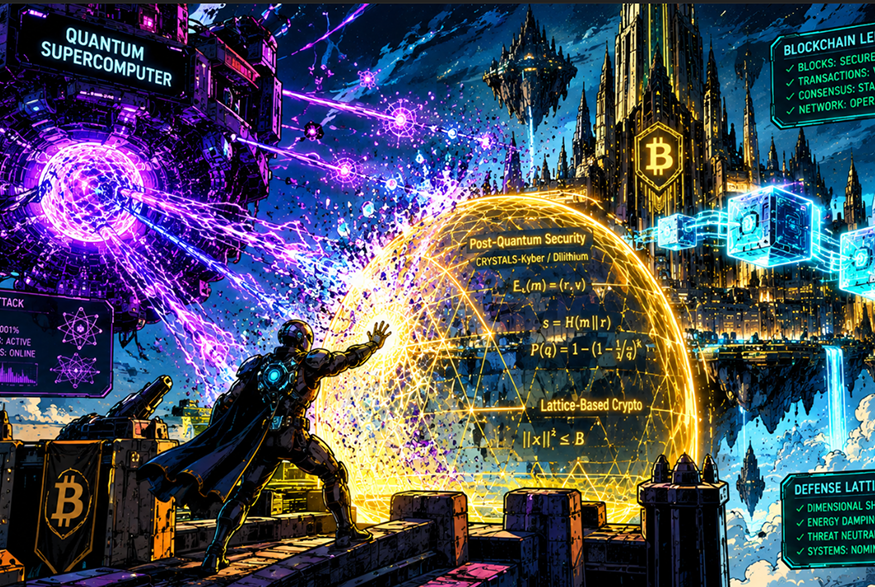
Integrating post quantum cryptography blockchain security standards has transformed from a distant academic debate into an immediate engineering priority for decentralized infrastructure. Modern public blockchains secure trillions of dollars in value using public-key cryptography—principally the Elliptic Curve Digital Signature Algorithm (ECDSA on secp256k1), Edwards-curve Digital Signatures (Ed25519), and Boneh-Lynn-Shacham (BLS12-381) pairing signatures. While these mathematical structures are virtually impenetrable by classical supercomputers, they possess an existential vulnerability: Shor’s algorithm running on a sufficiently powerful, fault-tolerant quantum computer.
A quantum processor with a few thousand stable, error-corrected logical qubits could execute discrete logarithm calculations in polynomial time, reversing a public key back into a private key in minutes. To ensure that immutable ledgers remain secure for decades, protocol developers, client teams, and enterprise custodians are redesigning blockchain consensus and account layers around post-quantum cryptography (PQC).
The Quantum Threat Surface: Where Chains Are Vulnerable
Quantum computers do not break all cryptography equally. Symmetric encryption (like AES-256) and collision-resistant hash functions (like SHA-256 and Keccak-256) are only quadratically weakened by Grover’s algorithm. Doubling the key or hash length effectively neutralizes this attack.
Instead, the quantum threat concentrates heavily on asymmetric public-key schemes across three distinct blockchain layers:
-
User Accounts and Transaction Signing: Standard externally owned accounts (EOAs) expose their public key the moment they broadcast a signed transaction. An attacker monitoring the mempool could theoretically calculate the private key before the transaction is finalized, executing a quantum-powered front-running attack.
-
Consensus Attestations (BLS Signatures): Proof-of-Stake protocols (like Ethereum’s Beacon Chain) aggregate tens of thousands of validator signatures into compact BLS proofs. Quantum compromise of BLS curves would allow malicious actors to forge validator attestations, execute double-spend reorganizations, and paralyze network finality.
-
Data Availability and Zero-Knowledge Proofs: KZG polynomial commitments (used in EIP-4844 blobs) rely on elliptic curve pairings. While STARK-based ZK systems rely entirely on quantum-resistant hashes, SNARK architectures dependent on elliptic curve toxic-waste setups face quantum obsolescence.
The New Cryptographic Primitives: NIST Standardization
The transition to quantum-safe blockchains relies heavily on the post-quantum standards finalized by the National Institute of Standards and Technology (NIST):
1. Module-Lattice-Based Digital Signatures (ML-DSA / FIPS 204)
Derived from the CRYSTALS-Dilithium algorithm, ML-DSA is based on the mathematical hardness of lattice problems (specifically, the Learning With Errors over rings/modules problem). It offers exceptionally fast signature verification and high security margins, making it the primary contender for replacing ECDSA in smart contract account verification.
2. Stateless Hash-Based Digital Signatures (SLH-DSA / FIPS 205)
Derived from SPHINCS+, SLH-DSA relies solely on the security properties of standard cryptographic hash functions rather than complex algebraic assumptions. Because hash functions are inherently resilient to quantum attacks, SLH-DSA acts as an ultra-conservative, highly secure backup algorithm, despite its larger signature footprint.
3. Hash-Based Validator Signatures (LeanXMSS)
For consensus layers where validator signatures must be aggregated at scale, Ethereum researchers are developing optimized implementations of stateful/stateless hash schemes, such as LeanXMSS. When paired with zero-knowledge virtual machines (zkVMs) that compress thousands of proofs into a single recursive STARK, networks can verify quantum-safe validator sets without overwhelming network bandwidth.
Overcoming the Scalability Trade-Off: Key and Signature Sizes
The central engineering challenge of implementing PQC on blockchains is data overhead. Classical elliptic curve signatures are remarkably compact, but post-quantum alternatives require significantly more block space:
| Cryptographic Scheme | Security Type | Public Key Size | Signature Size | Primary Blockchain Use Case |
ECDSA (secp256k1) |
Classical Elliptic Curve | ~33 bytes | ~65 bytes | Legacy Bitcoin & EVM EOAs |
| BLS12-381 | Classical Pairing Curve | ~48 bytes | ~96 bytes | PoS Validator Aggregation |
| ML-DSA-65 (FIPS 204) | Post-Quantum Lattice | ~1,952 bytes | ~3,309 bytes | Next-Gen Smart Accounts |
| SLH-DSA (FIPS 205) | Post-Quantum Hash-Based | ~32 bytes | ~7,856 to 17,088 bytes | High-Security Long-Term Vaults |
| LeanXMSS + zkVM | Compressed Hash Proof | Variable | Highly Compressed via STARK | Scalable L1 Consensus Finality |
Because an ML-DSA signature is roughly 50 times larger than an ECDSA signature, blindly swapping algorithms would choke block propagation and cause massive gas fee spikes. To mitigate this, networks are implementing recursive proof aggregation—bundling hundreds of post-quantum signatures into a single, compact zero-knowledge proof before writing to the canonical state.
The Migration Roadmap: Account Abstraction as the Trojan Horse
Blockchains cannot undergo a reckless, overnight hard fork to rewrite core signature rules. Instead, the migration is deploying across a multi-phased roadmap:
-
Hybrid Smart Accounts via Account Abstraction: ERC-4337 and account abstraction protocols (such as EIP-7702) allow user wallets to decouple signature verification from core protocol rules. Users can voluntarily upgrade their accounts to verify both an ECDSA key and an ML-DSA lattice key in a “dual-signing” hybrid model today.
-
Consensus Layer Shielding: Core developers are testing zkVM-powered validator aggregation pipelines on specialized devnets, preparing the consensus layer to replace BLS pairings with hash-based aggregators well ahead of any physical quantum advantage.
-
Proactive Address Hygiene: Wallets are encouraging users to avoid address reuse. An address that has never sent an outgoing transaction exposes only its public key hash (which is quantum-safe), keeping inactive funds shielded until the owner migrates to a native PQC wallet.
The Bottom Line
Deploying post quantum cryptography blockchain security is an engineering requirement that cannot be deferred until quantum hardware breaks classical cryptography. Because migrating decentralized consensus engines, wallet software, and DeFi smart contracts requires years of coordination, the industry is laying the groundwork now. By adopting NIST lattice and hash-based standards, compressing signatures through recursive STARKs, and utilizing programmable smart accounts, Web3 networks are building an unshakeable cryptographic foundation capable of surviving the quantum era.