
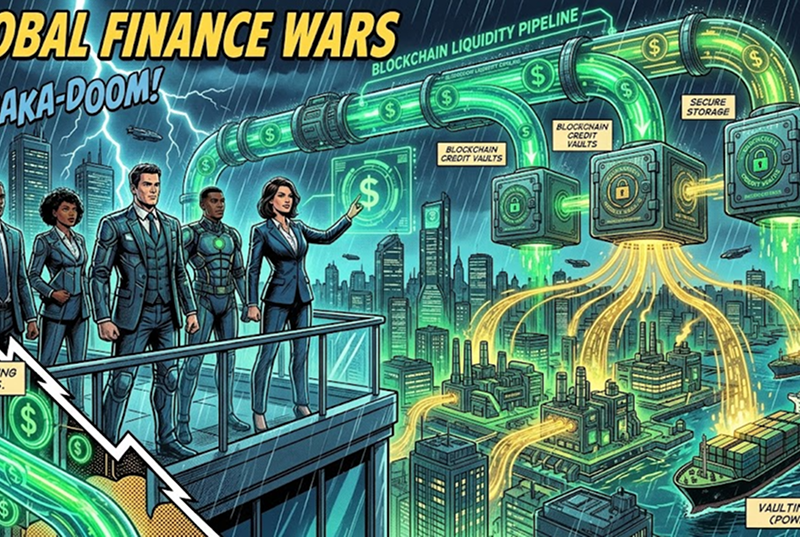
Accelerating tokenized private credit liquidity is reshaping the multi-trillion-dollar alternative debt market as institutional capital migrates onto public ledgers. During the initial wave of real-world asset (RWA) tokenization, institutional allocators concentrated their digital balance sheets almost exclusively in tokenized U.S. Treasuries to capture baseline, risk-free yields. However, as global central banks adjusted interest rates and yield spreads shifted, allocators expanded their digital asset strategies into higher-yielding private debt instruments.
The traditional private credit market—surpassing trillions in global assets under management—has long grappled with foundational inefficiencies: prolonged multi-year capital lockups, manual paper-based subscription documentation, fragmented loan servicing, and a near-total absence of secondary market trading. By migrating corporate loan origination, debt securitization, and yield settlement onto distributed ledgers, tokenized private credit protocols are transforming static, bilateral credit agreements into dynamic, composable digital assets.
Macro Drivers Accelerating On-Chain Debt Allocation
Institutional investment firms, family offices, and crypto-native foundations are directing capital into on-chain private debt markets due to three fundamental economic catalysts:
1. Attractive Real Yield Spreads Over Sovereign Assets
While short-term government debt tokens offer baseline yields between 3% and 5%, tokenized private credit assets deliver annualized yields ranging from 8% to 14%. This yield spread provides an institutional-grade, cash-flow-backed return that compensates allocators for private corporate credit risk without exposing them to the erratic volatility of algorithmic DeFi reward tokens.
2. Programmatic Cash Flow Distribution and Lower Servicing Costs
In legacy private lending, administering debt instruments involves a complex chain of intermediaries—including corporate trustees, payment calculation agents, and escrow banks. Smart contract automation handles daily loan accounting, automated escrow settlement, and programmatic distribution of repayments, reducing fund securitization and operational costs by up to 85%.
3. Continuous On-Chain Auditing and Collateral Visibility
Traditional private credit funds provide loan portfolio updates via delayed quarterly PDF reports. In contrast, on-chain credit protocols deliver transparency through real-time data feeds and distributed audit registries. Lenders can track borrower repayment schedules, collateral coverage ratios, and cash-flow health on an immutable ledger at any moment.
Structural Mechanics: Originating and Tokenizing Private Debt
To satisfy regulatory standards while maintaining decentralized liquidity, tokenized private debt operates across a three-stage lifecycle:
-
Off-Chain Origination and Legal Structuring: A corporate borrower (such as a trade finance operator, fintech lender, or real estate firm) completes conventional off-chain credit underwriting. A dedicated Special Purpose Vehicle (SPV) is formed as a distinct legal entity to hold the underlying commercial debt instruments and sign the loan covenants, ensuring token holders possess an enforceable claim under commercial bankruptcy law.
-
On-Chain Tranche Tokenization: The SPV mints digital tokens representing fractional participation in the debt facility. Protocols often structure these into senior and junior risk tranches. Senior tranches offer lower, secured yields shielded by first-loss capital, while junior tranches absorb initial defaults in exchange for elevated returns.
-
Permissioned Investor Onboarding: Capital allocators complete automated KYC/AML verification and accreditation checks to receive on-chain wallet authorization. Investors supply stablecoins (such as USDC) into the designated vault and receive yield-accruing tokens that automatically reflect ongoing borrower interest payments.
Operational Comparison: Traditional Private Debt vs. Tokenized Credit
| Operational Metric | Traditional Private Debt | Tokenized Private Credit Platforms |
| Typical Net Yield | 7% to 11% (Net of substantial management fees) | 8% to 14% (Lower administrative drag) |
| Settlement Velocity | T+5 to T+30 (Manual wire transfers and clearing) | T+0 (Atomic on-chain stablecoin settlement) |
| Investor Liquidity | Multi-year lockups (3 to 7 years) | Periodic redemption vaults and secondary ATS trading |
| Minimum Ticket Size | $5,000,000+ (High institutional barrier) | Fractionalized access for qualified allocators |
| Reporting Frequency | Quarterly delayed PDF statements | Continuous real-time on-chain accounting |
Overcoming the Secondary Market Liquidity Hurdle
While tokenization introduces the technical capability to transfer debt tokens instantly, building deep secondary trading volume remains the primary engineering frontier.
Unlike standardized public equities, private credit facilities are bespoke financial contracts. When an allocator wants to exit a loan position before maturity, potential buyers require up-to-date visibility into the borrower’s operating financials. To address this, protocols are integrating dynamic credit evaluation models, Automated Market Maker (AMM) pools designed for yield-bearing debt tokens, and integrations with regulated Alternative Trading Systems (ATS). This structure allows funds to access periodic liquidity windows without destabilizing the borrower’s long-term financing runway.
The Bottom Line
The expansion of tokenized private credit liquidity marks a permanent convergence between traditional structured finance and blockchain execution. By replacing fragmented spreadsheets and manual settlement cycles with programmable debt contracts, real-time collateral auditing, and flexible yield tranches, tokenized private credit has moved from an experimental niche into the primary engine driving institutional capital on-chain.