
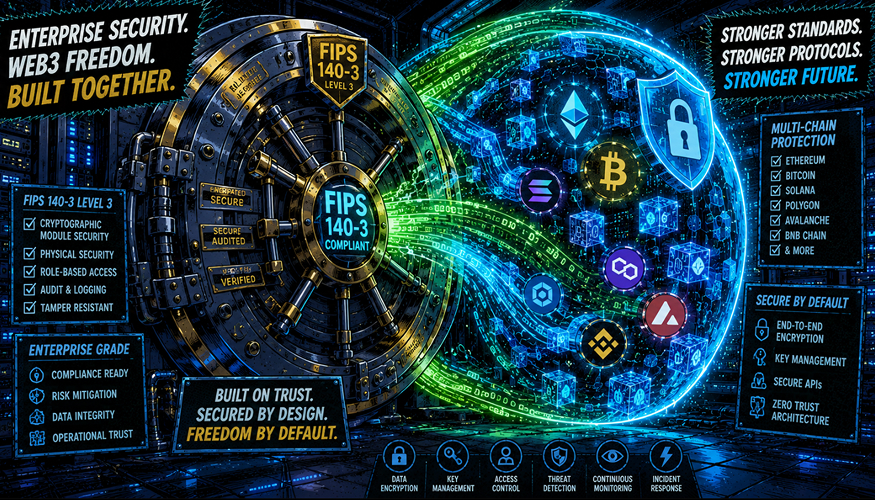
When tier-one banks, sovereign wealth funds, and regulated asset managers prepare to enter Web3, they face a non-negotiable requirement: institutional-grade cryptographic key security. While retail crypto users manage wallets via browser extensions or consumer hardware seeds, corporate treasuries handling billions of dollars in digital assets cannot rely on informal key management setups.
For decades, traditional financial institutions (TradFi) have relied on Hardware Security Modules (HSMs)—tamper-resistant, dedicated physical hardware appliances designed to generate, store, and manage cryptographic keys under strict regulatory certifications like FIPS 140-2/3 Level 3 and PCI-HSM.
However, bridging legacy banking hardware with the fast-moving world of decentralized blockchains isn’t plug-and-play. Successfully deploying traditional hsm web3 integration requires adapting monolithic enterprise security hardware to support multi-chain signing algorithms, high-velocity DeFi interactions, and hybrid cryptographic frameworks like Multi-Party Computation (MPC).
The Collision of Two Cryptographic Standards
The fundamental challenge of integrating traditional HSMs into Web3 stems from a divergence in cryptographic standards. Traditional enterprise HSMs were originally engineered to secure credit card processing, payment clearing networks (like SWIFT), PKI root certificates, and corporate SSL sessions. Consequently, their embedded firmware was optimized primarily for cryptographic curves like RSA and ECDSA using the secp256r1 (NIST P-256) curve.
Conversely, public blockchain networks operate on vastly different cryptographic primitives:
-
Bitcoin and Ethereum (EVM): Require signature generation on the
secp256k1elliptic curve. -
Solana, Cardano, and Near: Utilize the Edwards-curve Digital Signature Algorithm (Ed25519 /
ed25519). -
Zero-Knowledge Proofs & Restaking: Utilize specialized Pairing-Friendly BLS curves (
BLS12-381) for aggregating validator attestations.
Early traditional HSM appliances simply could not execute native signatures on secp256k1 or ed25519 inside their isolated, hardware-protected boundaries. To support Web3, major HSM vendors (such as Thales and Futurex) and institutional custody architects developed specialized firmware extension modules—often referred to as custom cryptographic extensions or composable modules—enabling legacy physical hardware to perform native, high-speed blockchain signing operations.
Architecture Models: Static Vaults vs. Hybrid MPC + HSM
Institutions generally implement one of two primary architectural frameworks when connecting enterprise HSMs to Web3 infrastructure:
[ Traditional Bank Vault (HSM) ] ──> ( Programmable Policy Engine ) ──> [ On-Chain Settlement ]
                                              │
                                              ▼
                             [ Hybrid MPC Key-Share Co-Signing ]
1. Direct HSM-Backed Cold Storage
In this model, private keys are generated directly inside an air-gapped or network-attached physical HSM. The private key never leaves the tamper-evident hardware boundary under any circumstances.
-
Strength: Delivers maximum legal and regulatory compliance. Auditors, regulators, and insurance underwriters favor this model because it aligns directly with existing banking compliance frameworks (e.g., SOC 2 Type II, ISO 27001, and NYDFS trust charters).
-
Operational Trade-Off: Low transaction velocity. Signing requires calling strict hardware APIs, making it cumbersome for high-frequency trading, real-world asset (RWA) minting, or complex DeFi smart contract interactions.
2. The Hybrid MPC + HSM Root of Trust Model
To combine institutional security with the agility required for Web3, modern custodians deploy a hybrid architecture combining Multi-Party Computation (MPC) with physical HSMs.
-
Instead of a single private key stored in one place, the key is mathematically divided into multiple encrypted “key shares” distributed across independent cloud environments and physical locations.
-
The primary “master seed” or critical threshold key-shares are held and processed directly inside a FIPS 140-3 Level 3 validated HSM, acting as the ultimate root of trust.
-
When a transaction is initiated, the secondary MPC nodes co-sign off-chain while the HSM validates the hardware-enforced policy rules before producing its signature share. This eliminates single points of failure while maintaining millisecond-level execution speeds.
Comparison of Institutional Key Management Paradigms
| Feature / Metric | Legacy Enterprise HSM | Native Multi-Sig Wallets | Hybrid MPC + HSM Stack |
| Primary Root of Trust | Physical FIPS-Validated Chip | On-Chain Smart Contract Logic | Distributed Math + Hardware Root |
| Signing Velocity | Low to Moderate | Slow (High Gas Fees on-chain) | High (Off-chain threshold signing) |
| Multi-Chain Flexibility | Requires Firmware Updates | Limited to Supported Smart Contract L1s | Universal (Chain Agnostic) |
| Regulatory Acceptance | Gold Standard (TradFi Native) | Moderate / Variable | High (Rapidly Becoming Industry Standard) |
Programmable Policy Engines: The Missing Link
Placing private keys inside an HSM prevents physical and remote key theft, but it does not protect an institution from malicious internal operators or unauthorized transaction requests. If an authenticated administrator submits a bad transaction to an HSM, the device will blindly sign it.
To solve this, traditional hsm web3 integration relies on intermediate Programmable Policy Engines. Positioned between the enterprise’s application layer and the physical HSM, the policy engine enforces strict business rules before any transaction payload reaches the hardware signing module:
-
Quorum Governance: Mandating that transactions over $1,000,000 require approval from 3 of 5 executive key-holders across different corporate roles.
-
On-Chain Whitelisting: Restricting the HSM from generating signatures for any destination address that is not on a pre-approved compliance list.
-
Transaction Simulation & Sanction Screening: Automatically running dry-run simulations on incoming smart contract calls and screening target contracts against real-time sanction databases prior to HSM dispatch.
The Bottom Line
Bringing institutional capital on-chain requires bridging the gap between legacy compliance standards and decentralized networks. By upgrading traditional Hardware Security Modules with multi-curve blockchain firmware, combining them with flexible MPC key management, and enforcing automated policy engines, financial institutions can establish bulletproof custody architectures. Far from being obsolete legacy hardware, traditional HSMs serve as the crucial hardware root of trust driving global enterprise Web3 adoption.