
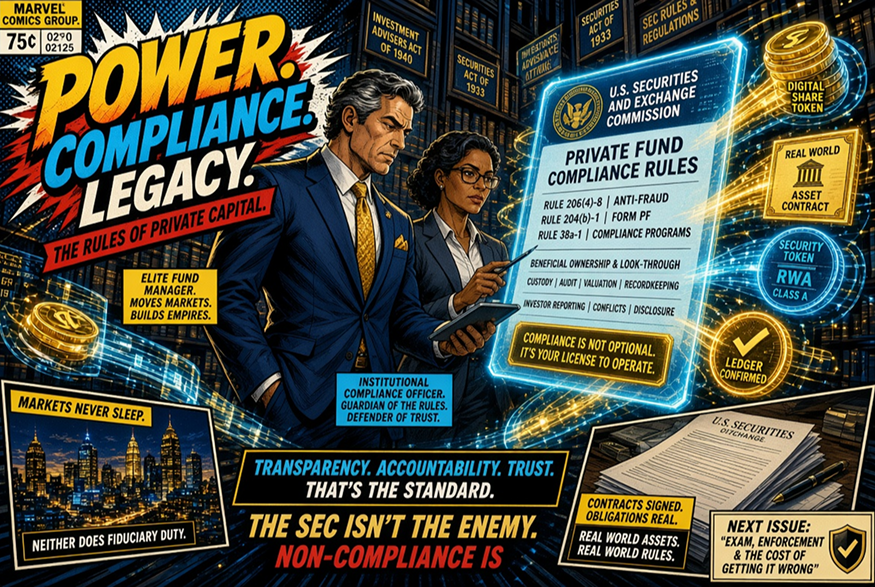
Navigating tokenized private funds sec registration standards is the single most critical legal hurdle for private equity, venture capital, and private credit managers bringing fund shares on-chain. For decades, investing in private funds required mountains of paper-based subscription agreements, manual cap table maintenance, and clunky LP transfer processes. Tokenization transforms these traditional fund shares into programmable digital securities, enabling 24/7 fractional transfers, automated compliance checks, and instant cap table reconciliation.
However, wrapping fund equity in an ERC-20 smart contract does not exempt a manager from federal securities laws. Under SEC guidance, tokenized fund shares are legally treated as traditional investment contracts and securities. To structure a tokenized fund legally within the United States, sponsors must navigate a multi-layered compliance architecture spanning the Securities Act of 1933, the Investment Company Act of 1940, and the Investment Advisers Act of 1940.
Securities Act Compliance: Safe Harbor Exemptions
Rather than undergoing a full public registration (an Initial Public Offering requiring Form S-1), nearly all institutional tokenized private funds rely on private placement exemptions under Regulation D or Regulation S.
-
Rule 506(c) of Regulation D (General Solicitation): The overwhelming majority of tokenized fund sponsors utilize Rule 506(c). This safe harbor allows managers to publicly market and discuss their tokenized offering across digital platforms. In exchange, the sponsor must take “reasonable steps to verify” that 100% of participating investors are verified Accredited Investors.
-
Rule 506(b) of Regulation D (Non-Public Offering): Allows up to 35 sophisticated non-accredited investors, but strictly prohibits general solicitation or public marketing.
-
Regulation S (Offshore Offerings): Used for non-U.S. investors. Smart contracts must enforce strict geo-fencing and transfer lockups to prevent tokens from flowing back into the hands of unverified U.S. persons.
Investment Company Act: 3(c)(1) vs. 3(c)(7) Exemptions
Under the Investment Company Act of 1940, pooling capital from multiple investors to invest in securities automatically classifies a vehicle as an investment company, triggering strict reporting requirements unless an exemption is established.
Tokenized fund sponsors structure their Special Purpose Vehicles (SPVs) or fund master structures under two primary statutory exemptions:
Section 3(c)(1): The Emerging Fund Framework
-
Investor Cap: Strictly capped at a maximum of 100 beneficial owners.
-
Investor Standard: Requires Accredited Investor status (individuals with $1M+ net worth excluding primary residence or $200k+ annual income).
-
Tokenization Risk: Because smart contracts allow fractionalized asset transfers, fund sponsors using 3(c)(1) must code hard limits into their transfer logic to ensure the on-chain cap table never breaches 100 unique beneficial owners, which would cause an immediate loss of exemption.
Section 3(c)(7): The Institutional Scale Framework
-
Investor Cap: Permits up to 2,000 Qualified Purchasers without triggering Section 12(g) Exchange Act reporting obligations.
-
Investor Standard: Significantly higher threshold—individuals must own at least $5,000,000 in investments, and entities must hold at least $25,000,000 in investable assets.
-
Use Case: The standard structure for institutional tokenized vehicles (such as tokenized private credit funds and Treasury trusts), providing the capacity needed for wide institutional distribution.
Technical Enforcement: Embedding Compliance into Smart Contracts
In a compliant tokenized private fund, legal rules cannot live solely inside a paper Private Placement Memorandum (PPM); they must be directly coded into the token standard itself (such as ERC-3643 or ERC-1400).
-
Permissioned Identity Whitelisting: The token contract does not allow arbitrary peer-to-peer transfers. Every wallet address must be cryptographically linked to an off-chain identity that has completed KYC/AML and accreditation verification.
-
Automated Transfer Restrictions: The contract enforces mandatory holding lockups (such as Rule 144 one-year seasoning periods for restricted securities) and blocks any trade where the buyer lacks proper investor clearance.
-
Cap Table and Registry Mirroring: The smart contract maintains a deterministic registry of token holders, ensuring that the general partner (GP) and fund administrator always hold an auditable, legally binding record of beneficial ownership.
Key Requirements for Private Fund Tokenization
| Regulatory Layer | Core Legal Mandate | Technical Implementation |
| Securities Act (1933) | Exemption from registration via Regulation D (Rule 506(c)). | Mandatory third-party accredited investor verification before whitelisting. |
| Investment Company Act (1940) | Exemption via Section 3(c)(1) or Section 3(c)(7). | Coded maximum holder caps (100 for 3(c)(1)) or Qualified Purchaser gates. |
| Investment Advisers Act (1940) | Custody Rule compliance and RIA fiduciary oversight. | Assets held by qualified institutional custodians with segregated accounting. |
| Secondary Market Trading | Must trade via broker-dealers or licensed ATS venues. | Smart contracts prevent unapproved P2P transfers outside registered platforms. |
The Bottom Line
Meeting tokenized private funds sec registration requirements is about embedding securities law directly into blockchain code. By pairing Regulation D safe harbors with Section 3(c)(7) structures and programmable identity-gated token standards, fund managers can modernize their capital stack. Tokenization provides the liquidity, operational efficiency, and transparency of decentralized ledgers while remaining fully anchored within institutional compliance standards.