
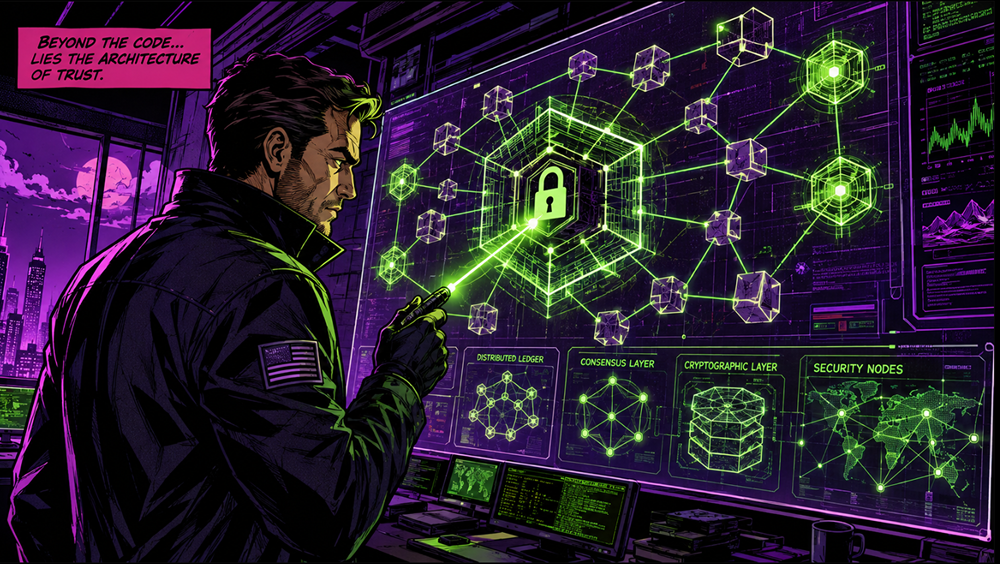
Let’s be completely honest: the term “Layer 2” has become a massive marketing blanket. For a long time, the crypto space assumed that anything using zero-knowledge proofs was inherently safe, bulletproof, and decentralized. But as billions of dollars in institutional liquidity pour into the ecosystem, we have to face a harsh reality: not all rollups are created equal, and some are running on absolute training wheels.
Evaluating zk rollup security isn’t just about checking if the math works. It requires looking at the entire structural machinery—from who controls the emergency keys to where the transaction data actually lives. If you are an asset manager or a developer looking to deploy capital, you need a cold, hard framework to separate true cryptographic fortresses from glorified centralized sidechains.
The Illusion of Cryptographic Infallibility
The core selling point of a ZK rollup is beautiful: it uses mathematical proofs (SNARKs or STARKs) to prove that off-chain transactions are valid before settling them on the Layer 1 mainnet. In a perfect world, this means the L2 inherits the exact security profile of the underlying base layer.
But we don’t live in a perfect world. We live in a world of smart contracts, upgrade bridges, and human operational risk.
If the smart contract governing the bridge on Ethereum has a logic flaw, the soundness of your ZK proof doesn’t matter. The funds can still be drained. Therefore, a real security evaluation must look past the cryptographic proofs and audit the operational parameters that actually govern the live network.
The Evaluation Framework: Four Pillars of True Security
To accurately measure the risk profile of any ZK network, your team must audit four critical infrastructure layers:
1. The Upgrade Mechanism and Timelocks
Most live ZK rollups use proxy smart contracts, meaning the core development team or a foundation can upgrade the code to fix bugs. However, an upgrade function is also a backdoor.
-
The Audit Check: Does the protocol use a multi-signature wallet with an absolute zero-day upgrade path, or is there a mandatory timelocks delay? If a team can upgrade the contract instantly without warning, a single compromised multi-sig key can steal every dollar in the bridge. A secure network requires at least a 7 to 14-day timelock, giving users ample time to withdraw their funds if a malicious upgrade is pushed.
2. Escape Hatches and Forced Transactions
What happens if the sequencer—the central server that batches transactions—goes offline, censors you, or gets shut down by regulators?
-
The Audit Check: A secure ZK rollup must feature a functional “escape hatch” built directly into the L1 smart contract. If the sequencer refuses to process your transaction, you must be able to interact with the L1 contract directly to force a withdrawal of your funds. If this mechanism is missing or “paused” by the developers, your capital is effectively trapped at the whim of a centralized operator.
3. Data Availability (DA) Integrity
A ZK proof proves that a state transition is valid, but it does not inherently publish the underlying transaction data. If the sequencer disappears and the transaction data is unavailable, users cannot reconstruct the state of the ledger to calculate their balances.
-
The Audit Check: Where does the data live? True ZK rollups publish their state diffs or transaction data directly onto the L1 mainnet (Calldata or Blobs). Protocols that offload this data to external, cheaper third-party data availability layers or centralized committees are technically “Validiums,” not rollups. Validiums drastically reduce transaction costs, but they introduce separate consensus and security assumptions that institutional risk models must account for.
4. Prover Decentralization and Phase Training Wheels
Most networks operate in distinct evolutionary phases. In the early stages, the prover—the engine that generates the mathematical proofs—is entirely run by the core team.
-
The Audit Check: You must evaluate the roadmap toward decentralized proof generation. If the system relies on a single prover and that prover fails, the entire network stalls. A robust framework tracks whether the protocol has transitioned to an open, competitive marketplace of independent provers, eliminating the single point of failure.
The Bottom Line
Zero-knowledge technology is the undisputed future of blockchain scaling, but deploying capital based on marketing buzzwords is financial suicide. A protocol isn’t secure just because it has “ZK” in its title.
By systematically analyzing upgrade timelocks, forcing mechanisms, data availability choices, and prover decentralization, you can strip away the hype and see the architecture for what it truly is. True zk rollup security is found in the code that allows you to escape the system when everything else fails.