
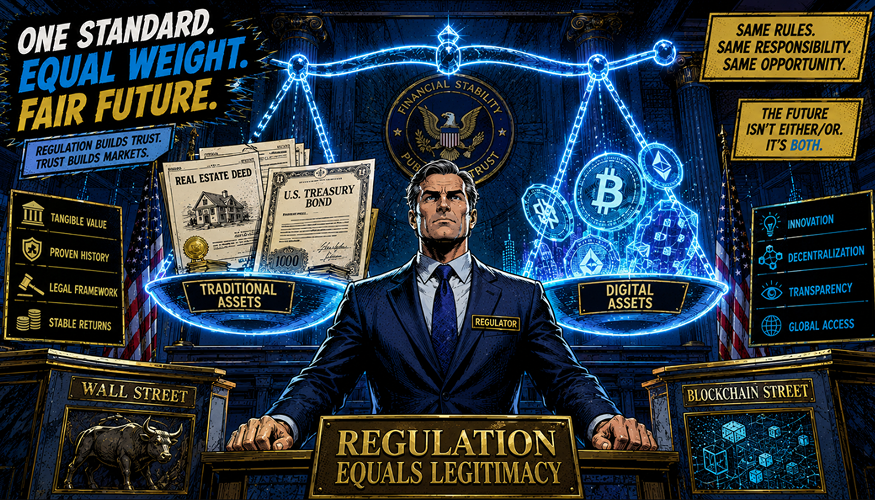
Real-World Asset (RWA) tokenization has rapidly evolved from an experimental crypto trend into a fundamental restructuring of traditional capital markets. From tokenized U.S. Treasuries and private credit to fractionalized real estate, Wall Street institutions are bringing hundreds of billions of dollars onto distributed ledgers. However, moving physical or traditional paper assets on-chain introduces a critical legal question: how do regulatory authorities view these digital claims?
Navigating sec guidelines tokenized rwa requires understanding that U.S. regulators take a substance-over-form approach. Wrapping an asset in a smart contract does not magically alter its underlying economic reality or exempt it from federal securities laws.
The Fundamental Rule: Technology Neutrality
The foundational stance of the Securities and Exchange Commission (SEC) regarding tokenization is “technology neutrality”. Formatting an asset as an ERC-20 token or an on-chain record does not change the core legal analysis.
If an underlying financial instrument meets the definition of a security under Section 2(a)(1) of the Securities Act—such as a stock, bond, or investment contract—the resulting tokenized version is inherently classified as a digital security.
The SEC taxonomy groups digital assets into distinct buckets. While pure digital commodities, digital tools, and certain payment stablecoins may fall outside traditional security classifications, tokenized RWAs representing economic claims on income-generating assets sit squarely within federal securities regulation.
Classification Taxonomy: Native vs. Wrapped RWA Tokens
SEC statements and staff guidance divide tokenized real-world assets into two main structural categories:
1. Issuer-Backed Native Tokenized Securities
These are digital securities issued directly on a blockchain by or on behalf of the primary asset issuer.
-
Structure: The blockchain serves as the official registry of ownership. Dividend payouts, shareholder voting, and transfer restrictions are programmed directly into smart contracts (such as ERC-3643 or ERC-1400 standards).
-
Regulatory Treatment: Fully subject to standard registration requirements (e.g., Form S-1) or private placement exemptions (e.g., Regulation D, Regulation S). The token is the underlying security.
2. Third-Party Wrapped Tokenized Securities
These occur when an independent entity buys a traditional asset (e.g., U.S. Treasury bills), places it inside a Special Purpose Vehicle (SPV) or trust, and issues tokens representing a fractional beneficial interest in that custodied pool.
-
Structure: The physical or traditional asset remains locked with a qualified custodian, while the on-chain token acts as a “digital twin” or derivative receipt.
-
Regulatory Treatment: Subject to intense scrutiny under both the Securities Act and the Investment Company Act. The issuer must prove that the SPV structure maintains a strict 1:1 backed claim, that custody arrangements meet institutional regulatory standards, and that secondary market trading enforces strict KYC/AML transfer restrictions on-chain.
The Howey Test in the RWA Context
When tokenizing physical non-security assets—such as commercial real estate, art, or commodities—classification hinges on the classic Howey Test. A tokenized physical asset is classified as an “investment contract” (and thus a security) if it involves:
-
An Investment of Money: Purchasing the token.
-
In a Common Enterprise: Pooling investor funds inside an SPV or property management vault.
-
With an Expectation of Profits: Anticipating rental yield, capital appreciation, or interest payouts.
-
Derived from the Managerial Efforts of Others: Relying on a third-party developer, property manager, or protocol team to generate returns.
If a project tokenizes a commercial building and promises passive rental yields managed by a third-party team, the token is an investment contract security, regardless of whether the physical building itself is a security.
Compliance Checklist for Tokenized Asset Platforms
| Operational Layer | SEC Compliance Requirement |
| Investor Onboarding | Mandatory integration of automated on-chain KYC/AML screening and investor accreditation checks before wallet whitelisting. |
| Custody & Settlement | Off-chain assets must be held by qualified custodians, with clear legal mapping connecting token ownership to enforceable off-chain claims. |
| Secondary Market Trading | Transfers must occur on registered Alternative Trading Systems (ATS) or platforms operating under valid broker-dealer exemptions. |
| Disclosures & Reporting | Transparent reporting regarding smart contract risks, counterparty custodian risks, and explicit details on how managerial efforts generate yield. |
The Bottom Line
Applying sec guidelines tokenized rwa models confirms that tokenization is an infrastructure upgrade, not a legal loophole. Whether tokenizing traditional financial securities or physical assets, issuers must build automated regulatory logic into their smart contracts. By embedding identity verification, transfer restrictions, and institutional custody into on-chain architecture, market participants can successfully unlock global digital liquidity while remaining fully compliant with federal securities laws.