
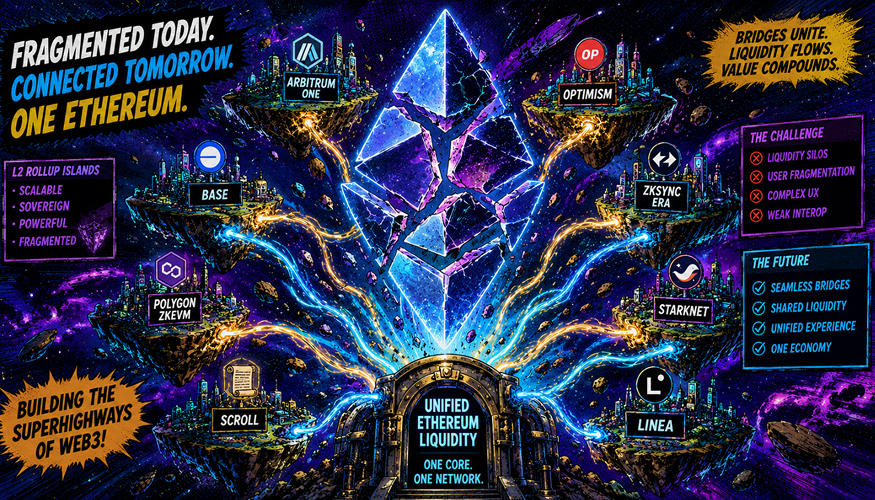
The explosive adoption of Ethereum scaling solutions has delivered sub-cent gas fees and massive transaction throughput. However, this rapid expansion created a major structural trade-off: capital siloing. With dozens of optimistic rollups, ZK-rollups, and application-specific chains operating independently, market depth has been split across isolated execution environments.
Assessing liquidity fragmentation Ethereum Layer 2 ecosystems requires looking past aggregate Total Value Locked (TVL) metrics and evaluating how capital dispersion affects execution quality, market efficiency, and cross-chain user experience.
The Anatomy of Liquidity Fragmentation
When liquidity is locked inside disparate Layer 2 networks without seamless cross-chain interoperability, market efficiency degrades across several key areas:
-
Slippage Spikes and Thin Order Books: A $500,000 stablecoin swap that executes with zero price impact on a unified network can suffer severe price slippage when split across multiple small L2 pools.
-
Inefficient Arbitrage Loops: In a unified ledger, arbitrageurs instantly close price gaps between trading venues. On fragmented L2s, cross-chain arbitrage faces bridging latency, withdrawal delays (e.g., 7-day challenge periods for optimistic rollups), and cross-rollup messaging costs.
-
Capital Efficiency Loss: Liquidity providers (LPs) are forced to split their capital across multiple chains to capture yield, diluting their fee generation and increasing risk exposure.
Key Metrics for Assessing L2 Liquidity Fragmentation
Institutional risk managers and DeFi architects evaluate four quantitative dimensions to measure capital fragmentation across rollups:
[ L2 Liquidity Assessment ] ──> Evaluates ──> 1. Effective Liquidity Depth (Slippage)
                                            2. Cross-Chain Price Variance
                                            3. Bridge Latency & Transfer Friction
                                            4. TVL Concentration Ratio
1. Effective Liquidity Depth (0.5% Depth Test)
Instead of looking at total TVL, measure the actual dollar volume required to move the market price of a key asset (like ETH or USDC) by 0.5% on a specific L2 DEX. High TVL with shallow depth indicates passive, non-productive capital.
2. Cross-Chain Price Variance
Track the frequency and duration of price discrepancies for identical asset pairs across different rollups. Persistent price deviations indicate that arbitrage mechanisms are failing due to cross-chain latency or high bridging friction.
3. Bridge Latency and Capital Transfer Friction
Calculate the total time and gas cost required to migrate capital from one execution environment to another. High withdrawal times (such as optimistic rollup exit queues) create capital lockup penalties that worsen fragmentation.
4. Market Share Concentration Ratio
Evaluate whether capital is organically consolidating into a few dominant execution environments or remaining hyper-dispersed across dozens of low-volume “ghost town” rollups.
Comparison of Solutions to Resolve Fragmentation
| Interoperability Model | How It Works | Primary Advantage | Operational Trade-Off |
| Shared Sequencers | Multiple rollups share a single, distributed sequencer set to order transactions. | Enables atomic cross-rollup transactions and unified block ordering. | Requires rollups to opt into a shared sequencing protocol. |
| Intent-Based Architecture | Solvers execute user outcomes off-chain and settle across chains on behalf of the user. | Completely abstracts multi-chain complexity for the end user. | Introduces solver competition dependencies and temporary MEV exposure. |
| Unified Ecosystem Hubs | Ecosystems aggregate rollup state proofs into a single unified liquidity layer (e.g., AggLayer). | Retains L2 sovereignty while providing near-native cross-chain liquidity sharing. | Dependent on specific zero-knowledge proof aggregation standards. |
The Path Toward a Unified Ethereum Experience
The ultimate goal of the Ethereum scaling roadmap is to make dozens of distinct rollups “feel like one single chain”. As account abstraction, intent-based routing frameworks, and zero-knowledge proof aggregation mature, cross-chain friction is gradually disappearing.
By systematically assessing liquidity fragmentation Ethereum Layer 2 parameters—monitoring effective order book depth, cross-chain price variance, and solver execution efficiency—developers and institutional allocators can route capital dynamically to ensure optimal trade execution across the entire decentralized economy.