
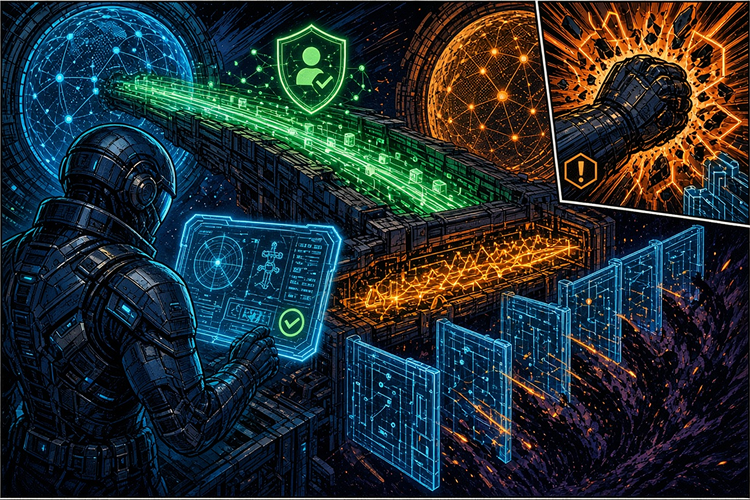
Conducting an institutional evaluation to audit cross-chain messaging protocols is a mission-critical mandate before deploying large-scale capital across fragmented blockchain ecosystems. Historically, cross-chain communication layers and asset bridges have represented the most targeted vulnerability surface in Web3, with exploit losses exceeding billions of dollars.
For institutional allocators, banks, and enterprise treasuries, cross-chain liquidity cannot rely on optimistic assumptions or marketing claims of decentralization. A catastrophic bridge exploit does not merely cause temporary slippage; it can result in total principal loss and fractured synthetic asset pegs.
Evaluating arbitrary messaging bridges (AMBs) such as LayerZero, Chainlink CCIP, Axelar, Wormhole, and native IBC requires an exhaustive, multi-layered auditing framework that dissects trust models, consensus finality, off-chain relay security, and automated disaster containment.
1. Classifying the Underlying Verification Topology
The foundational step of a cross-chain audit is categorizing how messages are validated between source and destination networks. Cross-chain architectures fall into three distinct security models:
-
External Verification (Multisig / MPC / Proof-of-Stake Clusters): A third-party set of validators or an off-chain Multi-Party Computation (MPC) federation attests that an event occurred on Chain A and signs a transaction authorizing execution on Chain B.
-
Audit Focus: The auditor must evaluate the economic cost to corrupt the validator set. If a $20 million bridge validation cluster secures $300 million in routed liquidity, there is a severe cryptoeconomic mismatch. The incentive to collude and forge state proofs exceeds the value of staked collateral.
-
-
Optimistic Verification (Watcher Networks): Messages are accepted on the destination chain provisionally, followed by a time-delay challenge window during which independent watchers can submit fraud proofs to halt malicious state assertions.
-
Audit Focus: Examine the latency and incentive mechanics of the watcher network. Is the challenge period long enough to accommodate Layer 1 congestion? If an attacker can front-run or censor fraud proofs during the dispute window via gas griefing, the optimistic security model collapses.
-
-
Native / Cryptographic Verification (Light Clients & ZK Relays): An on-chain light client on Chain B tracks the consensus headers of Chain A directly, using Merkle proofs or Zero-Knowledge Validity Proofs (zk-SNARKs/zk-STARKs) to mathematically verify that a transaction was included in a finalized block.
-
Audit Focus: Verify the validity of the light client contract logic, trusted setup assumptions (for ZK schemes), and how changes in the source chain’s validator set (e.g., PoS churn) are tracked without introducing trusted off-chain oracles.
-
2. Dissecting the Source-to-Destination Execution Lifecycle
Auditors must trace the full lifecycle of a cross-chain message to identify serialization flaws, race conditions, and relay vulnerabilities across four sequential stages:
[Chain A: Source]         [Off-Chain Transport]        [Chain B: Destination]
+------------------+     +----------------------+     +--------------------+
| Smart Contract   | --> | Relayers / Oracles   | --> | Verifier Contract  |
| Event Emitted    |     | (Data Transport)     |     | (Signature / ZK)   |
+------------------+     +----------------------+     +---------+----------+
                                                                |
                                                                v
                                                      +--------------------+
                                                      | Execution Engine   |
                                                      | (Payload Replay /  |
                                                      |  Gas Execution)    |
                                                      +--------------------+
Message Serialization and Parsing Integrity
Smart contracts encode arbitrary payload data on the source chain, which the destination contract decodes and executes.
-
Auditors must test for payload truncation, endianness mismatches, and ABI decoding edge cases.
-
Ensure that parsing logic cannot be manipulated to execute arbitrary calls on high-privilege contracts (preventing arbitrary remote code execution).
Replay and Re-entrancy Protection
-
Every cross-chain message must enforce globally unique, deterministic message identifiers:
$$\text{MessageID} = \text{keccak256}(\text{SrcChainID}, \text{SrcAddress}, \text{DstChainID}, \text{Nonce}, \text{Payload})$$ -
The destination contract must log processed nonces in a persistent nullifier bitmap to ensure no transaction payload can be replayed, even across network forks or bridge contract upgrades.
3. Re-org Handling and Finality Alignment
One of the most dangerous vectors in cross-chain messaging is the divergence of consensus finality rules between heterogeneous chains.
-
Probabilistic Finality (e.g., Proof-of-Work or non-finalized PoS): If an AMB reads a deposit on the source chain after only 2 block confirmations, a subsequent blockchain reorganization (re-org) could erase that deposit from the canonical chain. If the destination chain has already executed the message and minted assets, the protocol is left with an unbacked deficit.
-
Auditing Finality Checkpoints: Auditors must ensure the bridge enforces chain-specific safety buffers. For Ethereum, this means waiting for Casper FFG finality (two full epochs, ~12.8 minutes). For high-speed chains with dynamic validators, the protocol must verify BFT-style commit signatures rather than relying on optimistic mempool assumptions.
4. Defense-in-Depth and Institutional Fail-Safes
Code is never entirely immune to unknown zero-days. Therefore, an institutional-grade protocol must have active on-chain and off-chain defense mechanisms to contain systemic contagion:
| Security Primitive | Operational Function | Institutional Audit Requirement |
| Programmable Rate Limits | Restricts the volume of capital transferable within a rolling window (e.g., 1 hour / 24 hours). | Verify that volume caps scale dynamically with liquidity pool depth and cannot be bypassed by multi-transaction batching. |
| Independent Risk Networks (Dual Verification) | Requires two independent entities (e.g., an oracle and a relayer, or a secondary consensus network) to co-sign the message payload. | Confirm that neither entity can execute without the other, eliminating single-entity compromise risk. |
| Autonomous Circuit Breakers | Smart contracts pause inbound/outbound flows if an abnormal velocity or invalid state proof is detected. | Ensure emergency pause mechanisms are managed by a geographically decentralized multisig with time-delayed administrative controls. |
| Upgrade Timelocks & Emergency Councils | Enforces a mandatory delay (e.g., 48–72 hours) on any smart contract implementation updates. | Confirm that code updates cannot be executed unilaterally without affording institutional LPs time to withdraw capital. |
5. Institutional Audit Checklist
Before committing institutional capital to any cross-chain messaging pipeline, the compliance and security team must complete this formal scorecard:
-
Formally Verified Client Logic: Has the verification contract bytecode undergone formal mathematical verification to ensure state transition correctness?
-
Relayer Decentralization: Can anyone run a relayer to prevent transaction censorship, or is the relay mechanism hard-coded to a permissioned corporate server?
-
Cross-Chain Gas Abstract Sponsoring: How does the protocol handle gas price spikes on the destination chain? Are messages stuck indefinitely if destination gas limits exceed the source chain’s prepayment?
-
Insurance and Bad-Debt Socialization: In the event of a message exploit or double-spend, does the protocol have an on-chain reserve fund, or does the loss haircut depositors directly?
The Bottom Line
When preparing to audit cross-chain messaging protocols, institutional allocators must look beyond total value locked (TVL) and evaluate the mathematical hardness of the underlying transport layer. A truly secure cross-chain architecture minimizes trust assumptions through light-client and zero-knowledge verification, aligns strictly with source-chain finality guarantees, and enforces autonomous rate-limiting circuit breakers. Rigorous auditing against these criteria ensures institutional capital remains insulated from systemic contagion across the multi-chain financial ecosystem.
Related reading on Bitnesa
This article is for educational purposes only and is not financial, legal or tax advice. Crypto assets are volatile; do your own research before making decisions.