
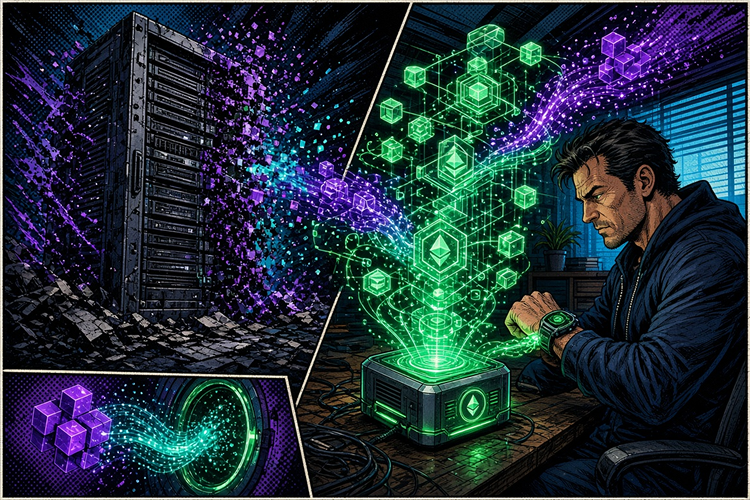
The implementation of ethereum statelessness validator hardware architectures represents one of the most significant structural shifts on Ethereum’s roadmap (codified as “The Verge”). Since genesis, running an Ethereum full node or validator has required operators to store the entire “world state”—the complete ledger of every account balance, smart contract code, and internal storage slot. As on-chain economic activity accelerated, global state size expanded past hundreds of gigabytes, demanding high-performance NVMe solid-state drives with multi-terabyte capacities to keep up with intensive random read-and-write operations.
This continuous accumulation of historical and state data creates a compounding threat: state bloat.
If storage and disk I/O requirements expand unchecked, running an execution node becomes prohibitively expensive for solo stakers and smaller enterprise entities, centralizing consensus verification into commercial data centers. Statelessness changes this paradigm fundamentally. By allowing consensus validators to verify state transitions without holding a copy of the world state on a local hard drive, stateless validation decouples node verification from physical disk capacity.
The State Dilemma: Stateful vs. Stateless Execution
To understand the operational impact on validator hardware, node operators must contrast the traditional stateful model with stateless execution:
-
The Stateful Model (Legacy Ethereum): When a block arrives, the validator’s execution client (e.g., Geth, Nethermind, Besu) executes each transaction against its locally stored Merkle Patricia Trie. The client computes the new state root, writes changes to disk, and attests to the block only if its local root matches the proposed header. This process requires persistent disk lookups, continuous drive write cycles, and multi-gigabyte memory caches to avoid I/O bottlenecks.
-
Weak Statelessness (Ethereum’s Target Architecture): Under weak statelessness, block proposers and specialized builders (within the Proposer-Builder Separation / PBS framework) continue to store the full state to assemble blocks. However, regular validating nodes and attesters do not. When a builder produces a block, it attaches a compact cryptographic “witness.” The witness contains only the specific state values accessed by transactions in that block, alongside mathematical proofs that these values exist in the canonical state tree.
-
Stateless Verification: The validator ingests the block and its attached witness, executes the block in transient memory, and mathematically verifies that the new state root is correct—all without querying a local database.
Cryptographic Enablers: From Merkle Patricia to Verkle and Binary Trees
Statelessness on Ethereum was historically blocked by witness sizes. Under the original Merkle Patricia Trie (MPT), generating a cryptographic proof for a complex block produced witnesses ranging from 3 to 18 megabytes. Transmitting an 18 MB proof across thousands of global nodes within Ethereum’s strict 12-second block slot would saturate peer-to-peer network bandwidth, triggering high uncle rates and chain reorgs.
The transition relies on new cryptographic data structures designed to compress proof sizes:
1. Verkle Trees and Vector Commitments
Verkle trees replace standard cryptographic hash functions with polynomial vector commitments (such as KZG or Inner Product Arguments). Instead of requiring a validator to ingest every sibling node along a trie’s path to the root, a single, constant-sized polynomial commitment can prove membership across wide branches. This shrinks typical block witness sizes from megabytes down to approximately 100 to 200 kilobytes—compact enough to propagate across the gossip network instantly.
2. Binary State Trees and zkEVM Verification
Alongside Verkle trees, ongoing protocol research evaluates binary hash trees paired with zero-knowledge validity proofs (zk-STARKs). Under this complementary design, the block builder generates a succinct ZK proof verifying that the block’s state changes are valid. Stateless validators simply run a constant-time cryptographic proof verifier, verifying validity without even re-executing transactions.
Validator Hardware Impact: Before vs. After Statelessness
Moving execution from persistent disk storage to transient memory verification reshapes the hardware profile required to validate Ethereum blocks:
| Hardware Component | Stateful Validator (Current Baseline) | Weak Stateless Validator (The Verge) |
| Storage Capacity | Minimum 2TB to 4TB NVMe SSD | ~64GB to 128GB (Minimal OS & client binary) |
| Storage Performance | High-end NVMe (TLC/DRAM cache, >50k IOPS) | Low-cost SSD or eMMC Flash Storage |
| Drive Endurance (TBW) | High wear from constant state writes | Negligible write degradation (Transient RAM ops) |
| RAM Requirements | 16GB to 32GB (Heavy state caching) | 4GB to 8GB (Witness execution in memory) |
| Network Bandwidth | Lower downstream (~1 to 2 Mbps) | Slightly higher downstream (~2 to 4 Mbps for witnesses) |
| Initial Sync Duration | Hours to days (Downloading & executing state) | Sub-second (Immediate validation from head block) |
Operational Transformations for Institutional and Solo Stakers
Decoupling validation from local disk storage introduces three primary operational improvements:
-
Instantaneous Node Synchronization and Recovery: Today, spinning up a new validator requires synchronizing hundreds of gigabytes of state data across the network via snap sync. A stateless validator requires no historical state download; it boots, receives the latest block header and witness, and begins validating transactions within the first slot.
-
Hardware Democratization: Eliminating high-IOPS NVMe requirements lowers the capital expenditure barrier for solo staking. Validation logic can run on low-power devices, mobile hardware, or micro-PCs without risking disk failure or dropped attestations due to I/O stalls.
-
Out-of-Order Block Validation: Because blocks carry their own self-contained state proofs, stateless validators can theoretically process incoming blocks asynchronously and out-of-order, optimizing CPU multi-threading across concurrent validation pipelines.
The Economic Trade-Off: Shifting the Burden to Builders
Statelessness is not without trade-offs; it redistributes operational complexity rather than eliminating it entirely.
While consensus validators become extremely lightweight, block builders and full archival nodes inherit the computational overhead of generating polynomial commitments and managing witness production. Generating complex Verkle witnesses or ZK validity proofs within strict sub-second builder auctions demands enterprise-grade computing clusters. This further reinforces the necessity of Enshrined Proposer-Builder Separation (ePBS), ensuring that while block construction remains specialized and competitive, block validation remains accessible to decentralized participants worldwide.
The Bottom Line
Understanding the relationship between ethereum statelessness validator hardware and network architecture reveals the long-term roadmap for Ethereum’s decentralization. By replacing multi-terabyte state databases with succinct cryptographic witnesses, weak statelessness transforms validators from heavy storage operators into nimble verification engines. While specialized builders manage the computational burden of proof generation, the broader validator set gains instant syncing, reduced memory overhead, and freedom from high-end NVMe requirements, securing Ethereum’s base layer across a diverse global hardware footprint.
Related reading on Bitnesa
This article is for educational purposes only and is not financial, legal or tax advice. Crypto assets are volatile; do your own research before making decisions.