
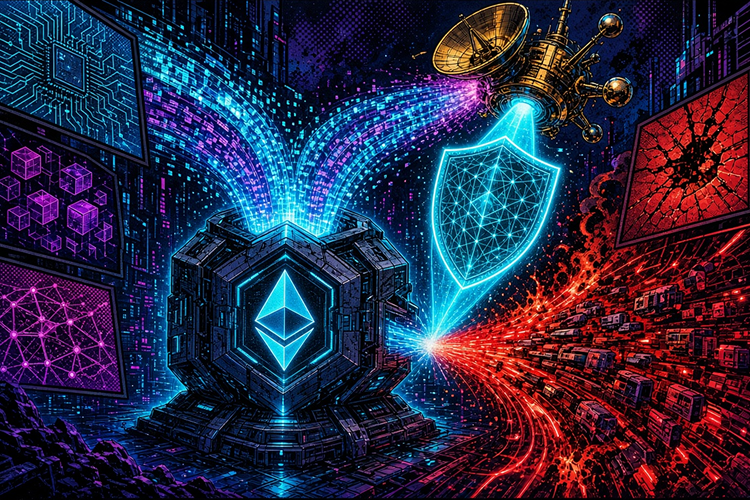
The utilization of zk coprocessors in scaling smart contract logic has emerged as the definitive solution for overcoming the strict computational limits of the Ethereum Virtual Machine (EVM). Historically, decentralized application developers faced a harsh architectural compromise: keep application logic simple to ensure affordable gas fees, or build complex logic and risk pricing users out of the protocol.
The EVM was designed to act as a highly secure, deterministic state machine, not as a high-performance computing environment. Operations involving complex floating-point mathematics, historical blockchain data queries across thousands of blocks, or machine learning algorithms are prohibitively expensive to execute on-chain. ZK coprocessors solve this by adopting the hardware architecture of traditional computing—where a CPU delegates intensive graphics rendering to a GPU—and applying it to cryptographic smart contracts.
The Computational Bottleneck of the EVM
To understand the necessity of ZK coprocessors, developers must first quantify the constraints of native on-chain execution:
-
Prohibitive Storage Costs: Storing and querying large arrays of historical data directly on Ethereum requires massive amounts of block space. Calculating a 30-day Time-Weighted Average Price (TWAP) natively on-chain requires loading thousands of historical states, resulting in exorbitant gas fees.
-
Lack of Native Floating-Point Math: The EVM does not natively support floating-point arithmetic. Implementing advanced risk engines, options pricing models (like Black-Scholes), or algorithmic yield optimization requires complex integer workarounds that bloat smart contract code and increase vulnerability surfaces.
-
State Bloat: Forcing heavy computation onto Layer 1 forces every validator in the network to replicate that exact calculation, contributing to state bloat and degrading overall network performance.
How ZK Coprocessors Function: The Architecture
A ZK coprocessor acts as an asynchronous, stateless computation environment. It allows smart contracts to trustlessly delegate heavy workloads off-chain and only verify the mathematical proof of the result on-chain. The workflow operates in four deterministic steps:
-
On-Chain Data Ingestion: The coprocessor trustlessly reads historical state, transaction logs, or receipt data from the blockchain. This is achieved by cryptographically proving the data against the blockchain’s historical block headers and state roots.
-
Off-Chain Computation: The heavy logic—such as running a credit scoring algorithm, calculating complex yield distributions, or executing a machine learning model—is processed in a specialized off-chain environment (the coprocessor).
-
Zero-Knowledge Proof Generation: The coprocessor generates a succinct cryptographic proof (zk-SNARK or zk-STARK) attesting that the computation was executed correctly according to the pre-agreed algorithm, and that the ingested data was accurate.
-
On-Chain Verification: The proof and the final output are sent back to the main smart contract. The EVM verifies the ZK proof in constant time, meaning the verification costs a flat, low gas fee regardless of how complex the off-chain computation was.
Key Institutional Use Cases for ZK Coprocessors
By decoupling computation from consensus, ZK coprocessors unlock entirely new verticals for institutional DeFi and Web3 applications:
-
Advanced On-Chain Risk Engines: Lending protocols can now implement dynamic, real-time liquidation thresholds based on multi-variable risk models. Instead of using static loan-to-value (LTV) ratios, the coprocessor can analyze a user’s entire historical portfolio volatility off-chain and update their specific margin requirements on-chain via a cryptographic proof.
-
VIP Volume Rebates and Loyalty Programs: Decentralized exchanges (DEXs) can reward high-volume traders by analyzing months of historical trading data. Instead of tracking every trade on-chain (which is cost-prohibitive), a coprocessor parses the historical logs off-chain, proves the user surpassed $10 million in volume, and triggers a fee tier upgrade on-chain.
-
Zero-Knowledge Machine Learning (zkML): Institutional biometric authentication or AI-driven trading algorithms can be executed securely. A coprocessor runs the machine learning inference off-chain and submits a proof that the model produced a specific output, enabling AI-managed funds on-chain without exposing proprietary model weights.
Comparative Analysis: Ecosystem Infrastructure
| Infrastructure Type | Primary Function | Compute Capacity | Trust Assumption |
| ZK Coprocessors | Verifiable off-chain computation & historical data access | High (Limited only by proving time) | Cryptographic Math (Trustless) |
| Layer 2 Rollups | Scaling generalized transaction throughput | Moderate (Bound by sequencer limits) | Cryptographic or Optimistic Fraud Proofs |
| Decentralized Oracles | Fetching external real-world data & basic compute | Low to Moderate | Cryptoeconomic Consensus (Honest Majority) |
Integrating zk coprocessors in scaling smart contract logic fundamentally alters the boundaries of decentralized application design. By moving the heaviest data processing and historical queries into off-chain cryptographic environments, developers are no longer constrained by the EVM’s gas limits. This architectural shift enables the deployment of institutional-grade financial instruments, complex risk management engines, and verifiable AI directly onto public blockchains, all while maintaining strict cryptographic security and minimizing transaction costs for the end user.