
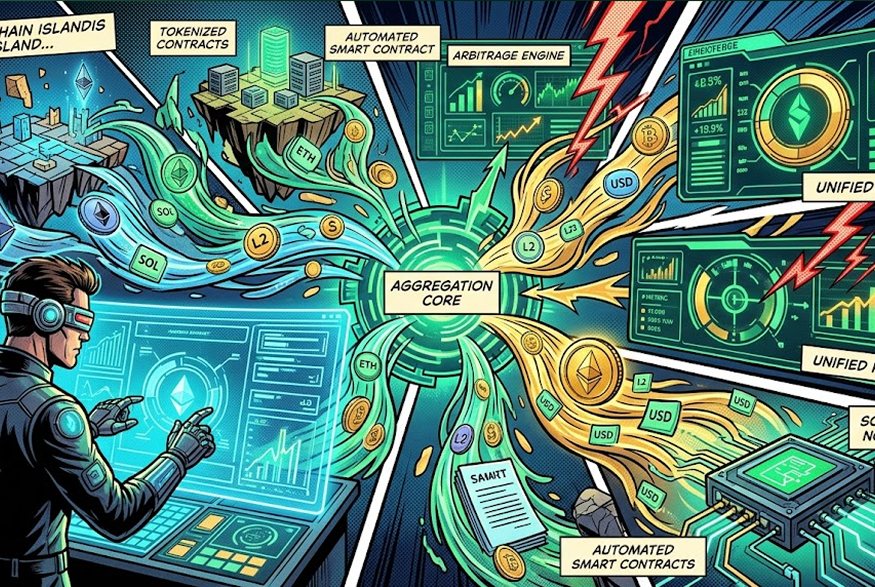
Analyzing cross chain liquidity aggregation layers is essential for understanding how the decentralized economy is combatting its most severe structural bottleneck: capital fragmentation. In the early stages of decentralized finance (DeFi), capital was largely concentrated on Ethereum. Today, the blockchain landscape has splintered into dozens of Layer 1 networks (such as Solana and BNB Chain) and an ever-expanding array of Layer 2 and Layer 3 rollups.
While this multi-chain expansion has dramatically reduced transaction fees and increased throughput, it has fractured the Web3 ecosystem into isolated liquidity islands.
When capital is scattered across separate environments, each individual pool suffers from reduced depth. For traders, this fragmentation imposes an invisible tax in the form of severe slippage, higher price impact, and inefficient execution. For liquidity providers, it results in underutilized capital and lower yield opportunities.
Cross-chain liquidity aggregation layers solve this fragmentation, transforming disjointed networks into a unified, highly efficient “universal liquidity layer” that optimizes the movement of digital assets.
The Cost of Multi-Chain Capital Fragmentation
In a fragmented market, executing an asset swap or yield-generation strategy across multiple chains creates immense friction. For example, a user wanting to move an asset from an Ethereum L2 to Solana typically has to manually connect to a third-party bridge, lock or burn the asset, wait for cross-chain validators to attest to the transaction, receive wrapped tokens on the destination chain, and then trade them for the desired native asset.
This multi-step pipeline introduces several economic inefficiencies:
-
Severe Slippage and High Gas Fees: Fragmented pools can rarely absorb large-volume trades without experiencing massive price impact. Compounding this, users must pay separate transaction fees on each intermediary network.
-
Bridge Counterparty Risk: Locking assets in bridge contracts exposes users to major security vulnerabilities, which has historically resulted in some of the largest exploits in DeFi history.
-
Time and Capital Inefficiency: Transactions can take anywhere from minutes to hours to settle, trapping capital in transit and causing users to miss rapid market opportunities.
The Economic Pillars of Aggregation Layers
Modern cross-chain aggregation layers eliminate these bottlenecks by abstracting away the underlying routing, bridging, and settlement steps, allowing users to execute complex multi-chain trades in a single, seamless interaction. This economic architecture is driven by three key pillars:
1. Intent-Based Routing and Solver Auctions
Rather than forcing users to specify the exact route, bridges, and DEXs required for a cross-chain swap, aggregation layers allow users to simply express their desired “intent” (e.g., “Exchange 10 ETH on Chain A for its maximum value in SOL on Chain B”).
This intent is broadcast to a competitive, permissionless network of “solvers” (or searchers). Solvers compete in real-time auctions to execute the user’s request. Because solvers must compete to offer the best price and fastest execution to win the auction, the economic benefit is passed directly back to the user in the form of optimal execution rates and minimized slippage.
2. Cross-Chain Arbitrage and Just-In-Time (JIT) Liquidity
Solvers often utilize their own off-chain and on-chain capital reserves to provide Just-In-Time (JIT) liquidity. A solver can instantly fill a user’s order on the destination chain from their own inventory and then settle the cross-chain balance asynchronously in the background.
By leveraging professional arbitrageurs to handle the bridging and rebalancing, the aggregation layer removes the waiting times and bridge vulnerabilities that usually burden the end user.
3. Unified Liquidity Pools and virtual AMMs
Protocols like Stargate, Thorchain, and deBridge utilize unified, shared liquidity pools or virtual Automated Market Makers (vAMMs) to support atomic native-to-native swaps. Instead of relying on wrapped assets, these systems hold pools of native assets (such as USD stablecoins or ETH) across multiple chains.
When a transaction occurs, the protocol’s contract locks or burns the asset on the source chain and instantly releases the native equivalent on the destination chain. This ensures that assets are atomic, secure, and free from the de-pegging risks of wrapped tokens.
Structural Comparison: Aggregation Architectures
| Parameter | Manual Bridging and Swapping | Aggregation Layers (AMM Route) | Intent-Based Solver Networks |
| Execution Complexity | High (User coordinates multi-chain steps) | Moderate (Protocol automates routing) | Low (Simplified, one-click user intents) |
| Slippage & Price Impact | High (Vulnerable to thin, fragmented pools) | Optimized (Splits routes across DEXs) | Minimum (Guaranteed by solver competition) |
| Settlement Time | Slow (Minutes to hours, manual bridging) | Rapid (Bridge-dependent automation) | Near-Instant (Solvers utilize JIT liquidity) |
| Security Profile | High risk (User exposed to bridge exploits) | Medium risk (Aggregator contract dependencies) | Low risk (Solver takes on bridge risk) |
| Capital Efficiency | Low (Siloed, underutilized capital) | Improved (Multi-hop routing) | Maximum (Continuous, solver-rebalanced depth) |
The Cross-Chain “Fragmentation Tax” Resolution
The ultimate goal of cross-chain liquidity aggregation layers is to drive down the “fragmentation tax.” Just as internet protocols (such as TCP/IP) abstracted away the complexity of routing data across isolated networks to create a single global web, aggregation layers are doing the same for digital capital.
By allowing any on-chain application to call contracts and tap into liquidity across multiple chains simultaneously, these protocols create a unified, highly efficient financial market.
The Bottom Line
The development of cross chain liquidity aggregation layers is the critical upgrade required for the multi-chain ecosystem to reach institutional scale. By replacing fragmented, high-slippage manual routes with automated solver auctions, just-in-time liquidity, and native-to-native swap networks, these layers are successfully merging the fragmented blockchain landscape into a unified financial engine. For Web3 to continue scaling, interoperability must feel invisible—and aggregation layers are delivering exactly that, maximizing capital efficiency for users and protocols alike.