
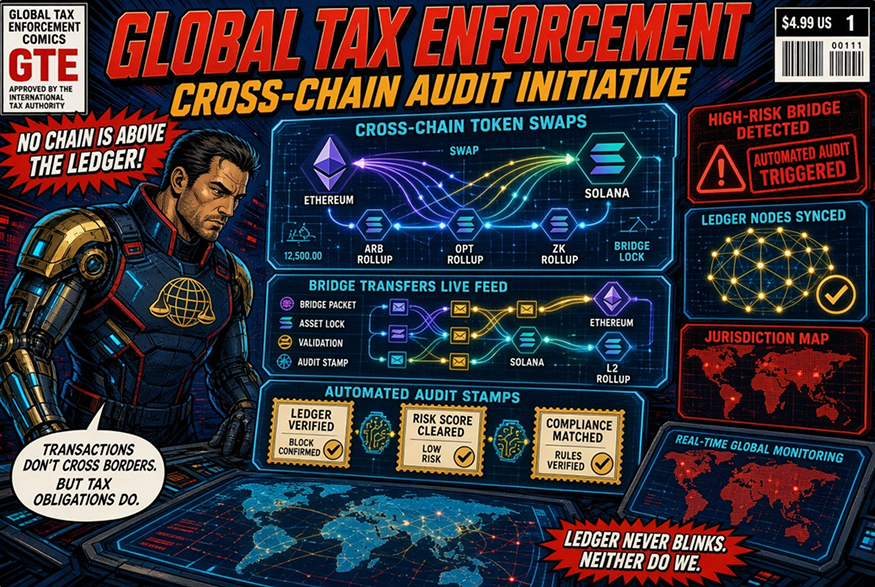
Adhering to cross chain defi tax transparency guidelines is now a fundamental requirement for decentralized liquidity protocols, cross-chain bridges, and institutional Web3 desks. Historically, decentralized finance operated under the assumption that pseudonymous smart contract interactions existed outside the reach of traditional sovereign reporting mandates. Unlike centralized exchanges that collect customer data at account creation, decentralized applications execute peer-to-contract transactions without storing names, tax residences, or identification numbers.
However, the international regulatory landscape has shifted aggressively. Driven by the OECD’s Crypto-Asset Reporting Framework (CARF) and regional implementations like the European Union’s Directive on Administrative Cooperation (DAC8), global tax authorities have established standardized rules for digital asset transparency.
These frameworks focus on economic substance rather than front-end terminology, creating compliance obligations for multi-chain liquidity providers, decentralized exchanges, and cross-chain messaging bridges.
The Regulatory Core: Understanding OECD CARF and DAC8
The Common Reporting Standard (CRS) successfully automated the exchange of offshore banking data for traditional finance, but it left decentralized digital assets largely unaddressed. CARF and DAC8 close this gap by creating an automated tax information pipeline tailored specifically to crypto assets:
-
Reporting Crypto-Asset Service Providers (RCASPs): Any individual or legal entity that provides services effectuating exchange transactions for or on behalf of customers—including crypto-to-crypto, crypto-to-fiat, and transfer routing—is classified as an RCASP.
-
Substance Over Form Doctrine: Protocols cannot evade compliance simply by marketing themselves as decentralized autonomous organizations (DAOs). If an identifiable foundation, core developer team, or multi-sig council exercises administrative privileges, controls liquidity routing fees, or manages user interfaces, regulators treat that entity as an RCASP.
-
Automatic Exchange of Information (AEOI): Once collected, user tax data and aggregated transaction volumes are filed via a standardized XML schema with domestic tax agencies, which then automatically share that data with the user’s home tax jurisdiction.
The Cross-Chain Challenge: Bridges, Wrappers, and Multi-Chain Liquidity
Cross-chain transfers present unique challenges for tax authorities. In a typical cross-chain interaction, a user locks native tokens on Chain A, receives wrapped assets via a bridge on Chain B, executes an automated swap, and bridges back to an unhosted wallet on Chain C.
Tax authorities have addressed cross-chain workflows with three strict reporting principles:
1. Bridge Operators and Service Provider Nexus
Cross-chain bridge aggregators and liquidity networks that charge execution fees or control relayer networks are increasingly classified within the RCASP perimeter. If an operator assists in executing an exchange between distinct asset categories across chains, they are obligated to conduct due diligence on reportable users where a legal nexus exists.
2. Transfers to Unhosted Wallets
Under CARF guidelines, reporting entities must treat transfers between custodial platforms and unhosted (self-custodial) wallets with heightened scrutiny. When a user deposits or withdraws assets across a cross-chain gateway, the service provider must record the external blockchain address, timestamp, token contract hash, and fiat-equivalent market value at the moment of execution.
3. Crypto-to-Crypto Disposals Across Networks
Tax frameworks treat swapping Token A on one network for Token B on another as a reportable taxable disposal, not a mere transfer. The user realizes a capital gain or loss at the point of bridge-swap execution, requiring protocols and institutional users to maintain unified transaction ledgers reconciled to the sixth decimal place.
Reporting Matrix: Decentralized Entities vs. CARF Scrutiny
| Platform / Protocol Architecture | Regulatory Classification | Mandatory Compliance Duties | Primary Audit Risk |
| Fully Autonomous Immutable AMM | Out of Scope (Pure Software) | None (No Identifiable Operating Entity) | Frontend DNS or RPC Gateway Nexus |
| DAO with Admin Keys & Sequencers | Presumed RCASP Entity | User Tax Due Diligence & TIN Collection | Reclassification as Unincorporated Partnership |
| Cross-Chain Bridge Aggregator | In-Scope Exchange Intermediary | Transaction Logging & Annual CARF XML Filing | Unhosted Wallet Routing Violations |
| Institutional Liquidity Vault | Financial Entity / RCASP | Full KYC, Tax Self-Certification, FATCA/CRS | Withholding Tax Non-Compliance Penalties |
Step-by-Step Compliance Checklist for Institutional DeFi Desks
Institutional participants and Web3 engineering teams must implement a structured compliance workflow to navigate global reporting standards:
-
Catalog On-Chain Wallet Trees: Map every corporate address across Layer 1s, Layer 2 rollups, and bridge contracts. Maintain deterministic audit trails that associate every cross-chain deposit, wrap, and unwrap with its underlying commercial purpose.
-
Integrate Standardized Valuation Oracles: Ensure accounting pipelines calculate asset acquisition and disposal values using reliable, timestamped fair-market-value oracle feeds denominated in standard fiat currencies (ISO 4217).
-
Deploy Identity Verification on Protocol Frontends: DeFi protocols seeking institutional capital must integrate zero-knowledge identity gates or permissioned smart contract pools. This allows institutional liquidity providers to provide certified tax residency declarations without publishing private PII directly to public block explorers.
-
Automate CARF XML Schema Compilation: Structure transaction data exports to align with the OECD’s standardized XML reporting schema, ensuring that incoming and outgoing cross-chain movements reconcile cleanly across domestic and foreign tax jurisdictions.
The Bottom Line
Implementing cross chain defi tax transparency guidelines marks the end of regulatory ambiguity for decentralized asset transfers. While immutable, fully autonomous smart contracts remain difficult for tax agencies to target directly, the interfaces, bridges, and institutional participants that route global capital are now firmly integrated into the international tax reporting apparatus. By building compliant accounting infrastructure, adopting automated transaction ledger tracking, and understanding RCASP obligations, organizations can engage with cross-chain liquidity while remaining defensible across global tax jurisdictions.