
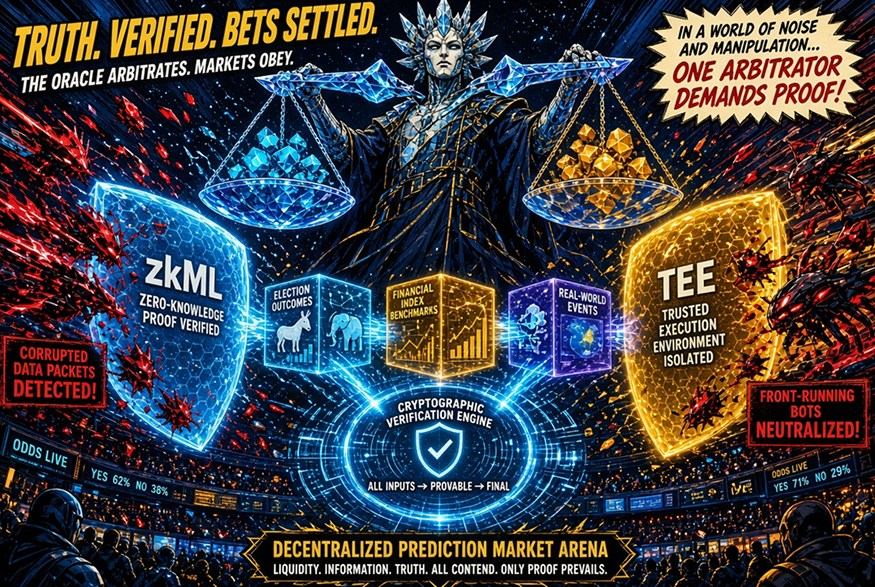
Deploying verifiable ai compute prediction markets architectures addresses the most vulnerable bottleneck in decentralized forecasting: the oracle resolution problem. While automated market makers and order books allow prediction platforms to trade millions of dollars on geopolitical elections, macroeconomic indices, sports, and court rulings, the ultimate payoff of every contract hinges on an external party answering a single question: What actually happened?
Traditional decentralized prediction markets rely on either centralized oracle feeds or subjective human voting escalation mechanisms (such as token-weighted dispute courts). Centralized feeds create single points of failure prone to tampering, downtime, and regulatory coercion. Conversely, human dispute systems introduce multi-day resolution delays, governance collusion vectors, and high coordinator fees.
By integrating verifiable artificial intelligence—powered by Zero-Knowledge Machine Learning (zkML), Trusted Execution Environments (TEEs), and multi-agent cryptographic attestations—protocols can achieve instant, objective, and tamper-proof market resolution across ambiguous, real-world events.
The Subjectivity Trap in Prediction Market Resolution
While binary events with clean numerical outputs (e.g., “Will the price of BTC exceed $100k on October 1st?”) can be settled by standard price oracles, the highest-volume prediction markets involve nuanced, real-world context:
-
Semantic Nuance in News Reports: Interpreting whether a regulatory statement constitutes a formal enforcement action or merely an exploratory inquiry.
-
Edge-Case Legal Rulings: Assessing appellate court stays, partial dismissals, and jurisdiction transfers where a simple true/false API output does not exist.
-
Delayed Public Filings: Parsing hundred-page regulatory transcripts, corporate balance sheets, and non-standard press releases in real time.
Human-driven consensus courts often fail in high-stakes environments because malicious cartels can purchase enough voting tokens to enforce an incorrect outcome, taking advantage of the protocol’s liquidity before token slashing can occur. Standard off-chain AI models cannot be trusted directly either; a centralized server running an LLM creates an opaque black box where operators could secretly tweak system prompts, alter temperature parameters, or hallucinate wrong outcomes without cryptographic proof.
The Verifiable AI Resolution Pipeline
Verifiable compute transforms artificial intelligence from an untrusted black box into a deterministic, cryptographically proven state machine:
-
Multi-Source Tamper-Proof Ingestion: The AI engine ingests real-time raw data (certified news feeds, government portals, court dockets) via decentralized oracle networks and cryptographic TLS-notarized proofs (such as zkTLS), guaranteeing that the source data was not altered in transit.
-
Confidential Model Execution in TEEs: The multi-agent evaluation model runs inside a hardware-isolated Trusted Execution Environment (e.g., AMD SEV-SNP or Intel TDX). The hardware generates a cryptographic attestation proving the exact bytecode and model weights executed without host manipulation or human memory injection.
-
Mathematical Zero-Knowledge Proof Generation (zkML): For targeted classification tasks, the inference is translated into a zk-SNARK or zk-STARK circuit. This produces a succinct mathematical proof demonstrating that a specific, pre-registered neural network evaluated the exact input data according to defined scoring rubrics.
-
Deterministic On-Chain Settlement: The smart contract receives the resolution verdict alongside the cryptographic proof. The contract verifies the proof in constant time on-chain; if the proof verifies, payout vaults unlock instantly without requiring multi-day human challenge windows.
Core Security Paradigms: zkML vs. TEE Attestation
Prediction market protocols balance speed, computational cost, and trust assumptions by combining cryptographic and hardware-enforced verifiable compute:
| Security Metric | Standard Centralized LLM | Trusted Execution Environments (TEE) | Zero-Knowledge ML (zkML) |
| Integrity Guarantee | None (Blind trust in operator) | Hardware-Enforced Cryptographic Attestation | Pure Mathematical Proof (SNARK/STARK) |
| Compute Overhead | Zero | Minimal (Near-native processing speed) | High (Substantial proving compute cost) |
| Model Size Support | Unconstrained (Billions of parameters) | Large (Full LLMs and multi-agent stacks) | Small to Moderate (Quantized specialized models) |
| Settlement Velocity | Instantaneous | Milliseconds to seconds | Seconds to minutes |
| Hardware Trust Assumption | Complete host trust | Silicon manufacturer root of trust | Fully trustless / Cryptographic math |
In production setups, a hybrid approach dominates: large multi-agent reasoning models run within TEE clusters to synthesize complex legal or news text, while lightweight zkML circuits verify the final numeric categorization thresholds on-chain.
Mitigating Adversarial Attacks and Prompt Injection
Deploying verifiable AI for financial settlement exposes protocols to adversarial inputs designed to manipulate the resolving engine. Robust verifiable prediction architectures deploy three defense layers:
-
Strict Context Isolation & Prompt Freezing: The model’s prompts, evaluation criteria, and system instructions are hashed and stored immutably on-chain at the moment the prediction market is created. The verifier contract rejects any resolution output derived from altered prompts.
-
Redundant Multi-Model Ensembles: Rather than relying on a single neural network architecture, multiple distinct models (running in diverse isolated enclaves) must independently reach quorum on the resolution verdict before a co-signed attestation is generated.
-
Optimistic Fallback Courts: Verifiable compute serves as the automated high-velocity tier. In the event of an unresolvable tie or verifiable circuit failure, an optimistic dispute bond can trigger a secondary tier, engaging decentralized human courts only as an exceptional last resort.
The Bottom Line
Implementing verifiable ai compute prediction markets architectures bridges the critical gap between real-world ambiguity and deterministic blockchain execution. By replacing slow, cartel-prone subjective courts and centralized API endpoints with cryptographically provable machine intelligence, prediction markets can resolve complex events instantly. Verifiable AI establishes an uncompromised oracle layer, providing the reliability, scalability, and transparency required for decentralized prediction markets to handle institutional volumes.